Showing posts with label Nova Scotia. Show all posts

Wednesday, May 25, 2016

Among the Tall Pines

Early rhododendrons

In Milton, Nova Scotia, just outside the town of Liverpool, there's a riverside park that is one of the area's natural treasures. Pine Grove Park was established by the Bowater Mersey Paper Company in 1987 to celebrate Queen's County being named as the Forestry Capital of Canada for that year. In the winter of 2012 it was turned over to the residents of the county.


Tall pines along the trail


With 1.6 km (one mile) of looping trails, a swimming beach, toilet facilities and a picnic area, it's a pleasant recreational park. In spring and early summer, though, the park is ablaze with blossoms: rhododendrons, azaleas, magnolias and other flowers are abundant and several woodland glade are perfect habitat for pink lady slipper orchids. Many of the flowering trees and shrubs were selected and donated by retired naval captain Richard Steele, an Order of Canada recipient known as "Captain Rhododendron".


Soft pink rhododendron blossoms


The Mersey River flows past Pine Grove Park, and provides nesting areas for teal and black duck. The winding trails make a marvelous place to break up a long drive with a peaceful walk through the tall pines. The park is just minutes from Nova Scotia Route 103 at Exit 19 and is well worth a stop if you're in the area.


Mersey River

Friday, May 06, 2016

Reflecting on Nature


While sorting through a few archived images for a project, I was struck with how many of them had one striking feature in common: reflections. Whether in sea water, glass or even wet pavement, this simple phenomenon has the power to captivate. I have to admit that I'm pretty much addicted to them. Sometimes the morning sun's low angle sets off a perfect combination of elements to create an unforgettable image.


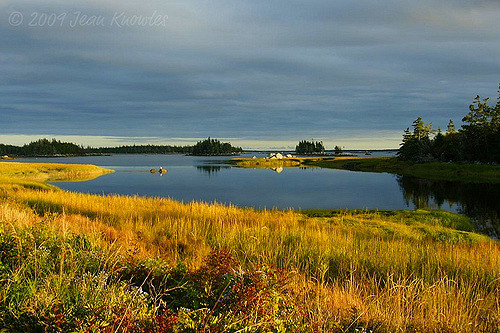
Sometimes it's the evening light that does it, turning marsh grass to gold, deepening the colours of the blue-grey clouds and painting the granite rocks a stark white, like this scene in Atwood's Brook, NS.


Blue Rocks, Nova Scotia, is a picturesque spot at any time, but the touch of the early morning sun on the golden shades of autumn can make it even more beautiful.


Evening's soft rose tones on a winter day can create a Rorschach sunset around the inshore islands. This is another scene from Atwood's Brook, NS.


A few sanderlings scouting for food at the water's edge make for some striking reflections in the wet sand of Daniel's Head Beach, Cape Sable Island, NS.

Sunday, May 12, 2013

I Like Big Boats and I Cannot Lie

I've always loved working boats, both big and small to be honest, and there are few places better suited to someone with a love of such boats than Atlantic Canada. From the sandy shores of Prince Edward Island to the tides of the Bay of Fundy, shared by Nova Scotia and New Brunswick, to the rocky coast of Newfoundland and Labrador, this region has a wealth of boats of all shapes and sizes.


They can be found in small towns and big cities, tied up at wharves, riding at anchor, or moored "on the collar" in small coves whose names don't appear on any map. The unifying thread among all these boats is their utilitarian grace. They're built for work, not for show, but they have an innate beauty that's a bit poignant somehow, as if try as they will, they just can't help being graceful and elegant.


These days their hulls might be fiberglass, metal or even concrete, but there was a time when every one of them had been built from wood in a local boat shop. Examples of those older wooden boats can still be found if you're willing to look; they might be housed in museums where they're carefully studied for their lines, hauled up on the shore and falling into ruin, or -- in some rare cases -- lovingly patched and mended and still afloat after seventy-five or a hundred years of plying the North Atlantic.


I particularly like those parts of the region where there's a lot of individuality expressed in the colours of the boats; those bright reds and yellows and blues and greens add cheer to a foggy day, and from a practical standpoint of those who wait on shore, it's a lot easier to recognize the boat you're looking for when it rounds the headland making for home. Although today's navigational and safety equipment have reduced the hazards, fishing is still a dangerous way to make a living; here's wishing safe home to all those boats, and to those who travel in them.


Tuesday, May 07, 2013

Comfort and Hospitality at the Clockmaker's Inn


The Clockmaker's Inn at Windsor, NS stands proudly at a spot called Curry's Corner; this stately home with its distinctive mansard roof was built in 1894 for local merchant Rufus Curry, who occupied it until his death in 1934; his widow, Cornelia, stayed on in the house until 1946.  After some thirty years, it was bought by Dennis and Veronica Connolly, who converted it to a bed and breakfast and named it after Sam Slick, the "Yankee clockmaker" who appeared in the tales of Judge Thomas Chandler Haliburton, a native of Windsor. The current owners acquired the property in 2005; the Inn as it appears today is shown above in a painting by artist David Howells.


Extensive renovations added three new suites on the third floor of the Inn like the well-appointed King's Suite shown above, adding to the five rooms and one suite on the second floor. The ground floor houses common rooms including the breakfast room, and is graced with several handsome fireplaces. 


Ornately carved woodwork, parquet floors, and handsome stained-glass windows give a gracious feel to the house, like this dramatic window, located on the landing of the main stairwell. 


Breakfast is hearty and cooked hot to order at the time of your choice, with choices like French toast, pancakes, omelettes and more; juice, coffee and tea, yogurt, cereals are available too, served buffet-style in the breakfast room.


The Clockmaker's Inn is owned and operated by the Dunhams, Debbie and Rick; their daughter Sarah, her husband Sean and their two adorable sons Frankie and Charlie. They provide a warm and friendly welcome. You'll find a link to the Inn's website here.

Friday, May 03, 2013

The Places Left Behind

I find myself drawn to abandoned buildings; there's so much mystery and poignancy about them, and they speak of lives left behind. Each one tells a story: houses that once were filled with life and laughter, shops that once saw a booming trade, or barns that once provided warmth and shelter for animals.


On a recent drive along the coast of Shelburne County between Port Saxon and Churchover via the Lighthouse Route, I stopped to look at two houses and a former general store. The first of the houses was in the village of Ingomar, on a stretch of road leading out of town toward the end of the point. I got out of the car to take a closer look, and when I took out my camera and shot through a broken window, a small animal chattered at me from inside. At least I think it was a small animal; I decided not to stay around long enough to find out.


The abandoned general store was also in Ingomar, on the main road leading into the community. Large windows had been boarded over, and next to the entrance door a thermometer on a metal backing had been hung from the wall. The glass appeared intact, but all the markings were lost in rust so I have no idea how warm -- or cool -- it was when I visited. I can imagine, though, that it was a selling tool in summer, when the proprietor could point out how hot it was, and convince the local children that a scoop of strawberry ice cream was the only logical way to cool down!


The second of the houses was at Gunning Cove, overlooking McNutt's Island and Shelburne Harbour. Like the first, it was of simple Maritime vernacular design, and likely would have been home to a good-sized family. From its location next to the water, it was probably the home of a local fisherman; there were lilac trees planted nearby to scent the breeze, and evidence of a garden that had been well-tended in its day.


The feeling that these buildings bring on is, for me, a mixture of curiosity and melancholy. Black and white felt like the right treatment for them.


Wednesday, May 01, 2013

Birchtown and the Black Loyalists

When ships filled with United Empire Loyalists dropped anchor at what was then Port Roseway, Nova Scotia, on May 4, 1783, among those on board were 936 free Blacks; in late August of that same year, a further 500 Black Loyalists arrived. These settlers were granted land along the inner reaches of the harbour, in an area that had initially rejected by the earlier group of arrivals. It was called Birchtown not because of birch trees that grew in the area, but in honor of New York Governo r Colonel Samuel Birch, who had not only provided them with certificates of freedom but had also strongly resisted the efforts of American authorities to re-enslave them. 


The ground here was extremely rocky and hilly, with poor prospects for agriculture; it was far from the near-paradise they had been promised before setting out for Nova Scotia. The Black loyalists persevered, though, and used the stones removed from the rocky ground to build fences and stone walls for livestock enclosures and divisions between fields.


The settlers encountered prejudice and outright bigotry from many white Loyalists, and low pay and poor treatment were commonplace. Birchtown's dwellings in most cases consisted of pit houses set below the ground's surface; this development was in response to the burning of houses by white rioters and opponents of the settlement, particularly in the Shelburne Riot of 1784 when out-of-work former soldiers blamed Black settlers for their continuing poverty and lack of employment opportunities.


By the 1790s the Black Loyalists of Shelburne had grown tired of shabby treatment and outright hostility from the area's white population and an exodus took place from Birchtown to Sierra Leone; ironically, the greatest opposition to this move came from some of the people who had been most active in the mistreatment and exploitation of Black workers. Conditions on the ships that carried the Birchtown residents to Sierra Leone, although not as horrific as those on the slave ships many had traveled on years before, were overcrowded and disease-ridden, and many Birchtown Blacks did not survive the crossing to Africa.

A small museum in the old Birchtown school house (top photo) relates the story of Birchtown's Black Loyalists, and plans are under way for a larger and more detailed exhibit.

To learn more about Nova Scotia's Black Loyalist heritage, I recommend Lawrence Hill's remarkable novel, The Book of Negroes (published in Australia, New Zealand and the U.S. as Someone Knows My Name).


Monday, April 29, 2013

Shelburne's Historic Waterfront


The town of Shelburne, on Nova Scotia's scenic South Shore, was one of several communities that were destinations for the United Empire Loyalists who fled the United States during and after the American Revolution, from 1775 to 1812. Known in the U.S. as Tories, they had remained loyal to Britain and had not supported the efforts of the revolutionaries, sometimes actively opposing them. On May 4 of 1783, ships carrying 3073 Loyalists from New York anchored in the harbour of what was then known as Port Roseway, dramatically changing the course of southwestern Nova Scotia's history.


Prior to their landing, the entire territory of Nova Scotia, which then included the present-day province of New Brunswick, had a population of less than 20,000.  By the end of 1783, over 35,000 Loyalists had arrived, overwhelming both the limited infrastructure and the ability of the government in Halifax to cope with the arrivals.


In July of 1783, the name of Port Roseway was changed to Shelburne to honour Lord Shelburne, Secretary of State for the colonies who had served briefly as Britain's Prime Minister in 1782.


By 1784, the population of Shelburne had swelled to over 10,000 -- the largest town in British North America and more than twice the size of Halifax. Eventually most of these Loyalists either returned to the United States as the political climate became less hostile, or moved on to other areas of Canada. They left behind a carefully laid-out town with streets named after members of the Royal Family, and a number of handsome and well-constructed homes and businesses. Today, Shelburne provides an interesting stop for the cultural explorer, with its cluster of museums and restored buildings. Shown here, from the top, are the Shelburne County Museum, the Ross-Thomson House, the Old Dory Shop Museum, and the impressive Cox's Warehouse, its cupola and spire added for the filming of The Scarlet Letter in 1995. 


Tuesday, April 23, 2013

Coffee at the Flying Fox

A walk around Shelburne, on Nova Scotia's South Shore a little over 200 km from Halifax, led me to an interesting discovery: the Flying Fox Bake Shop on John Street. Water Street is Shelburne's principal commercial street, running parallel to the waterfront and a block away. Dock Street runs along the harbour through the town's restored historic district, and connecting these two streets there are a series of smaller side streets like John Street, lined with handsomely restored older homes. 


An interesting sign caught my eye as I gazed down John Street toward the water, and I decided to check it out. It was early afternoon, and I was delighted to see the "Open" sign in the window. Entering the storm porch, I took note of the sign inside posting the hours: Noon to 10 pm. The owners, Julie and Jonathan Shand, came here from the Yukon. They opted for afternoon and evening opening since another coffee shop nearby had a well-established early morning clientele and the Shands wanted to be good neighbours.


Inside I was pleased to discover a comfortable room filled with light even on a rainy day. The walls were a soft shade of plum, a cheerful contrast with the calm aqua of the entry hall. Four tables with painted chairs filled the room nicely without crowding. I walked through to the counter to order a cup of their distinctive, full-bodied coffee, fresh from a French press. 


A lighted showcase was filled with a wide variety of sweet treats like mini cheesecakes and confections, and there were cookies and cupcakes as well, beautifully frosted to resemble flowers.


While enjoying my coffee, I took a closer look at the bright, bold paintings on the walls, the work of Holly Everett of Parker's Cove, NS, Artist of the Month for April. The Flying Fox provides gallery space for artists, so the display changes from month to month.

I'm grateful to serendipity for this discovery, and I'm certain that I'll be back to enjoy more great coffee and great art at the Flying Fox Bake Shop -- and next time that lighted showcase will yield up some of its treasure!


Thursday, April 11, 2013

The Advent of Spring


 Spring seems to be taking its own sweet time arriving this year; the early signs, like crocuses, appear then suddenly disappear under a drift of snow. Warm weather creeps in, the sun makes its presence known, then an icy breeze whips through the trees and we're back in what feels like the dead of winter. Last weekend, though, was one of those brief, enticing tastes of spring and the open road called.  In this case it was a very seldom-used road, one that was constructed to serve a Yarmouth County tin mine in the mid 1980s. The mine, when operating, was the largest primary tin mine in North America; the paved surface of the access road is deeply rutted from the weight of the ore-laden trucks that travelled it regularly, and the countryside is typical southwestern Nova Scotia: mixed hardwood and softwood, with occasional barrens and numerous rocky streams.


At the western end of this road, near Yarmouth, NS, the road crosses a tributary of the Tusket River, flowing through dense Acadian mixed forest. The water flows slowly, forming deep, still pools where trout tempt the angler -- the spring season has just opened and there are plenty of fishermen trying their luck.


A little farther west, near where Nova Scotia Route 203 intersects with Route 340, lies the town of Kempville, the site of one of many small-scale maple sugar operations.  Early spring sees sap buckets hanging from maple trees all over the region; although Nova Scotia's principal maple production is found well to the north of here, these operators manage to produce a small quantity of syrup each year, much sought-after locally. The buckets are a sure sign that elusive as it might be, spring is definitely on the way!


Sunday, April 07, 2013

Rising from the Ashes


White Point Beach Resort was in ruins. A fire on November 12, 2011 had burned the main lodge to the ground, a devastating blow to the 83-year-old seaside getaway. For decades, the lodge had housed an impressive dining room and facilities for a variety of entertainment; a history of the resort can be found here. The potential loss of employment sent shockwaves through the Liverpool, Nova Scotia area, since this was a vital employer of both seasonal and year-round workers.


The decision to rebuild was made almost immediately; the owners set up a webcam so that the public could view the progress of the construction.  Incredibly, less than one year later, on November 8, 2012, the doors of the newly rebuilt lodge re-opened. Like a phoenix, the resort had risen from the ashes, bigger and better than ever, more environmentally friendly and accessible, and with an array of new facilities.


The cabins that surround the main lodge remain, some more rustic than others. Rabbits, descendants of pets from a former era, still roam the grounds as living White Point mascots, and the waves still roll in along the beautiful stretch of white sand that gives the resort its name. It's good to see this grand old resort renewed and revitalized, and ready to welcome the public again.


Friday, April 05, 2013

Liverpool -- Planters and Privateers on Nova Scotia's South Shore

Before the arrival of shiploads of United Empire Loyalists to what are now Canada's Maritime Provinces in the 1780s, another wave of settlement had taken place. These settlers were  the New England Planters, who arrived in New Brunswick and Nova Scotia to settle in the lands left vacant by the expulsion of the Acadian population in 1755.  The first of these 8000 Planters began arriving in 1759 and the migration continued until 1768. There was farmland in southern New Brunswick and the Annapolis Valley, but along the South Shore of Nova Scotia it was mostly New England fishermen who arrived, settling in places like Barrington and Liverpool. 


Among the Liverpool settlers of 1762 was Simeon Perkins, born in Norwich, Connecticut, who established a thriving shop and built a shipping trade to support it. Perkins kept extensive and detailed diaries; from them we have gained most of our knowledge of Liverpool life between 1766 and 1812. His home, restored to that era, is operated as part of the Nova Scotia Museum. Because of their New England heritage, the people of Liverpool were initially sympathetic to the American Revolution, but their sympathies shifted after American privateers began capturing the town's trading vessels, Perkins' among them. Locals outfitted a schooner, the Liverpool Packet, captained by Joseph Barss, Jr., which became one of the most famous British privateer vessels of the time.


A side trip from the town of Liverpool offers winding roads along scenic coastline, marked with picturesque rocky coves like Moose Harbour with its collection of blue-and-white fishing boats (above), and smooth, wave-washed beaches like the one at Hunt's Point (below).


Liverpool is nearly two hours away from Halifax on Nova Scotia's Route 103, and those who choose to turn off the highway at this point will find a small service centre for the surrounding rural region; there are restaurants, a microbrewery,  and several hotels, as well as the usual selection of small-town services like filling stations, grocery stores, pharmacies and banks.


Thursday, February 28, 2013

"We went because they needed answers"

On February 17, 2013, the fishing boat Miss Ally, with five men aboard, was lost in a storm off the South Shore of Nova Scotia. The hull of the craft was sighted, but searchers chose not to examine it right away. At the request of the families of those on board, a full day before "official" crews examined the hull of the Miss Ally, four divers from Shelburne County had been to the hull to provide answers for those grieving families. Please follow this link to look into the faces of these true heroes of the community. Their heartfelt gift was to help in the only way they could.


Monday, February 25, 2013

The Scrapper


One fine evening while walking on the beach, I came upon one of life's little dramas.  The outcome was very different from what I expected when I arrived, for what I saw was a common rock crab,
Cancer irroratus, turned belly-up and lying quite still.  I thought it was dead, but much to my surprise when a wave rolled over it, the little crustacean, it righted itself and started to make its
way back to the sea.  I've decided to learn from this little fellow and roll with the punches.  Don't count yourself out until you've had a chance to roll over and start again!


Wednesday, February 20, 2013

Days of Sorrow


It's impossible to live in a small, closely-knit coastal community and not feel the effects of harrowing loss. Southwestern Nova Scotia is experiencing such sorrow, with the sudden and tragic loss of the halibut-fishing boat Miss Ally and the five young men on board.  The skipper was Katlin Nickerson of Wood's Harbour, and with him on the voyage were Joel Hopkins, Cole Nickerson, and Tyson Townsend, all of Wood's Harbour as well, and Billy Jack Hatfield from nearby Cape Sable Island.  The five set out in the 14-metre Cape Islander on February 12, 2013 to pursue the winter halibut fishery, which takes place in during the worst of winter's storms and gales. After the boat's emergency beacon was activated on Sunday night, searchers were hampered by sea conditions that included wind, freezing spray and waves of 10 metres or more. Several aircraft, two Coast Guard vessels and various merchant vessels took part in the search, but the search area was broad and the sea conditions far from ideal. The fishing communities of Southwestern Nova Scotia waited, tension thick in the air, while the search continued; nighttime brought a gesture of solidarity throughout the region as homes up and down the shore left a light on through the night to speed the men's safe return. It was all to no avail, though, as the search was called off on Tuesday evening.   In addition to other family members, the captain and crew of the Miss Ally leave behind a total of six children. Hearts are heavy along the shore today.

Wednesday, January 30, 2013

An Eighteenth-Century Inn

I recently had the pleasure of staying in a remarkable B&B, Lunenburg's Lennox Tavern. The building dates from 1791 and stands at the corner of Fox and Cornwallis Streets, not far from the impressive Lunenburg Academy. Lovingly restored by owner Robert Cram, the simple yet imposing Georgian structure dominates its setting. Robert has undertaken the inn's restoration himself, and was pleased to point out some of its many unique features. He
bought the place in its bicentennial year, 1991, after it had spent many years as a rundown apartment building. Its restoration has been a labour of love for Cram; remarkably, much of the original plaster, woodwork and doors and windows remained. These were supplemented with items bought at yard sales and antique shops and salvaged from derelict houses.

Cram visited historic homes and museums, and pored over architecture books and magazine articles on historic restoration. He discovered coins beneath the floorboards, and one dated "1791" embedded in the upper course of masonry in the fieldstone cellar, in keeping with German tradition of dating a house. He outlines the steps in the renovation here.

Today's guests have the opportunity to choose from four comfortable guest rooms furnished with antiques; two have ensuite bathrooms while the others share bathroom facilities. A hearty and varied hot breakfast is served in
the old Tavern's taproom, with its stenciled floors, based on the original design, traditional "dresser" style cupboard with an array of china platters, and its handsome fireplace. Stenciled chairbacks add interest to the seating in this room that's filled with natural light. Lennox Tavern is located on a quiet side street, away from the bustling scenes of Lunenburg's waterfront tourism district but within easy walking distance of downtown's historic streetscapes. It makes for an interesting and comfortable departure from mainstream hotel accommodation, and Robert Cram's passion for this long-term restoration project makes him a fascinating host.

Monday, June 18, 2012

LaHave Islands

The LaHave Islands lie just ten miles from Lunenburg, on Nova Scotia’s scenic South Shore. That’s ten miles as the crow flies, but unless you’re actually a crow then getting there takes a bit more time than you might expect. Travel along Route 332, the Lighthouse Route, to East LaHave, and from there take the cable ferry across the LaHave River -- it leaves the eastern side of the river at 15 and 45 minutes past the hour. Turn left after leaving the ferry, and proceed no farther than the delightful LaHave Bakery before continuing on your way. It’s essential to stop at this bakery
and cafĂ© to snack on fresh baked goods or enjoy delicious soups, light lunches, and a fine variety of teas, coffees, and cold beverages. You might like to pick up a loaf of bread to bring along as well; milk & honey, cheese & herb or multigrain are just some of the choices. Now that you’re properly provisioned, it’s time to continue west along the shore to Crescent Beach; the road to LaHave Islands runs parallel to the beach, behind the dunes. Take time to linger on this smooth strip of sand; although the seawater is usually too cold for swimming, it’s a great walking beach, well-used
by locals and visitors alike. During my most recent visit, there were several people wading hip-deep in the cold water, digging into the sand for surf clams (above right). They’d wisely chosen to wear wetsuits for this activity!

Back on the road, a bridge at the end of the beach/causeway leads to Bush Island, where a small but picturesque fishing harbour makes for interesting exploration. The next island is Bell Island; here you’ll find the LaHave Islands Marine Museum (top), housed in a former Methodist church. The eclectic collection of displays here pays tribute to the area’s seafaring past and to its farming history, as well as recognizing the contribution of the district’s veterans of the two World Wars. There are some fine examples of local boatbuilding, including large double dories and an example of a double-ended Bush Island boat christened the Vera Mae.

A little farther down the road lies the turnoff for Wolfe Gut, an out-of-the-way corner with lovely views of the shoreline. This is just one of the many peaceful spots that make a visit to the LaHave Islands worthwhile. The South Shore is a popular travel destination and can at times be busy and bustling during the summer months, but the LaHave Islands are a haven of calm and peaceful surroundings on a summer’s day.