Showing posts with label Coastal life. Show all posts

Wednesday, March 09, 2016

Exploring Rose Blanche

Rose Blanche Lighthouse
When approaching Rose Blanche, the most striking feature on the landscape is an impressive stone lighthouse, one of a series built between 1871 and 1873 along this coast. The Rose Blanche light is one of the last surviving stone lighthouses on the Atlantic Coast of Canada, and had fallen into disrepair by the 1990s, but the stone steps inside the tower were of such robust construction that they kept the building from falling down; restoration of the building was completed in 1999.

The Harbour at Rose Blanche

The little harbour of Rose Blanche is now accessible by road, but is still well off the beaten path so it sees fewer visitors than many more accessible Newfoundland communities. My own first visit here was on a superb July morning in 2015, on a cruise with  Adventure Canada. We dropped anchor just outside the harbour and made our way to shore in Zodiacs, landing at the public wharf and hiking to the lighthouse. The old path led around the inner harbour and over the hills, where the sun warmed berry fields and small ponds along the way. After seeing the lighthouse and the well-designed interpretation area at the end of the road, there was a warm welcome for the ship's passengers at St. Michael and All Angels Anglican Church on the hill overlooking the harbour.


Lighthouse Point
Looking seaward
Rose Blanche now shares government with neighbouring Harbour Le Cou, the subject of a well-known traditional song from Newfoundland, here performed by the group Ryan's Fancy. If you're visiting by road, the community is located on Newfoundland's scenic southwest coast, about 45 minutes east of Port aux Basques via provincial Route 470.


Lighthouse interior


Take a walk through Rose Blanche via Google Street View here. Amenities include bed and breakfast accommodations, shops and cafes.

Saturday, February 20, 2016

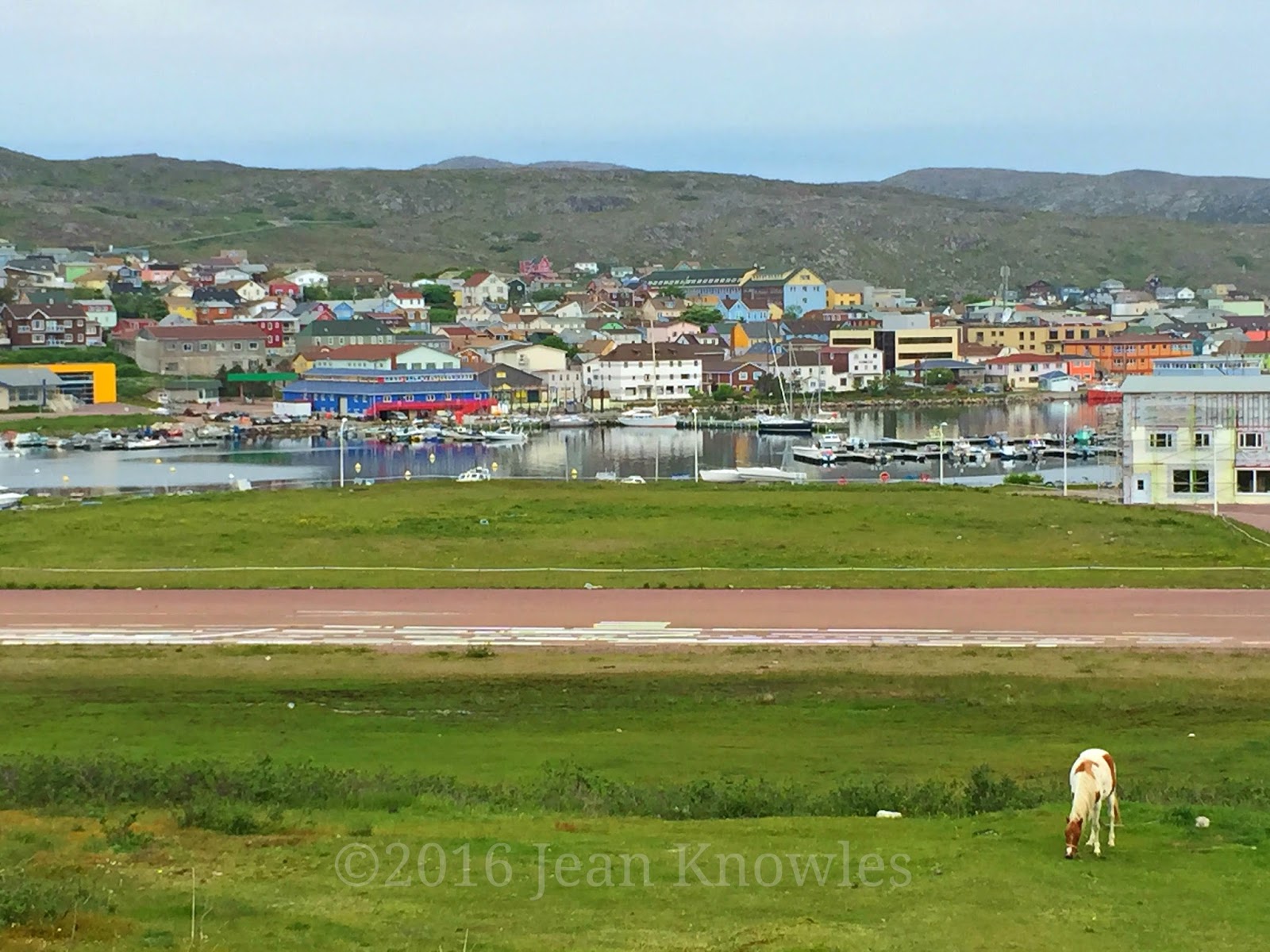
St. Pierre & Miquelon -- a true taste of Europe in North America

St. Pierre


Le Café du Chat Luthier
YJust west of Newfoundland's Burin Peninsula lie the islands of St. Pierre and Miquelon, France's last outpost in North America. This overseas collectivity of France has a population of a little over 6000, and is principally made up of two islands, St. Pierre -- more heavily populated and the smaller of the two -- and Miquelon-Langlade. A third island, Ile-aux-Marins, is located just off the town of St. Pierre and is no longer occupied. The islands lie a short ferry ride from the port of Fortune, Newfoundland and Labrador, or can be reached by air from Halifax, Montreal and St. John's; travel between St. Pierre and Miquelon can be accomplished by air or by local passenger ferry. The islands are also a popular stop for cruise ships both large and small; a great way to visit is on an expedition cruise like those offered by Adventure Canada; I first found my way here on their Newfoundland Circumnavigation, and will return in 2016 on their Mighty St. Lawrence cruise.


Miquelon
The two islands have distinctly different personalities; St. Pierre has a more cosmopolitan feel despite its small size, with restaurants, hotels and shops ranked along its narrow streets, while Miquelon has a much more rural and relaxed atmosphere. Both islands, though, boast brightly coloured houses and beautiful scenery. Wine shops, patisseries and cafes make for some great culinary experiences -- after all, this is France and the wines and baked goods are legendary. Just like in mainland France, a visit to a small shop will provide plenty of options for a light lunch, including locally produced chevre and fois gras. Remember that even though this is definitely France and locals tend to be very fashionably dressed, a good pair of walking shoes is essential.


Ile-aux-Marins
Tourism information centres can be found in both towns, and local sightseeing tours by van can be arranged. A water taxi to Ile-aux-Marins makes for an interesting addition; the island is used as a summer home by some local residents, and historic and cultural displays can be found there. The heritage of the islands' residents is varied; on Miquelon there are many descendants of the Acadians, expelled from New France by the British in 1755, and many islanders also trace their ancestry to the Basque region. Local residents are friendly and most speak excellent English; if you speak French this is a great opportunity to put it to use, but don't hesitate to go because of a language barrier -- you'll get along just fine in English.


Lobster on the menu!
St. Pierre boasts several very comfortable hotels in its central district, while Miquelon has bed and breakfast accommodations. Information on transportation to the islands and on local activities and culture can be found here. Currency is the Euro; both St. Pierre and Miquelon have banking machines where cash can be purchased, and credit cards are widely accepted.
See you in St. Pierre and Miquelon!


Thursday, March 28, 2013

Birdwatching on the Rocks


The sweet piping call of the black guillemot isn't easy to hear, but it signals the presence of one of Newfoundland and Labrador's most delightful seabirds. "Black guillemot" is a rather formal name for this little bird, whose scientific name is Cepphus grylle. In Scotland it's affectionately known as a tystie, it's often referred to in Newfoundland as a sea pigeon, and these days it's sometimes jokingly called a Newfoundland strobe light because of its bright white wing patches and wing liner feathers, which appear and disappear in flight creating a strobe pattern. It's at the small end of the size scale for our summer seabirds, and it's more skittish than puffins or even murres, so it's a bit more difficult to photograph. Patience pays off, however, since its glossy black feathers are strikingly handsome and its feet are bright, crimson red -- bright enough to be seen through clear water when the bird is swimming or diving below the surface in pursuit of food. The real surprise, though, comes when the black guillemot opens its mouth: the gape, too, is right red! 


The birds breed on rocky shorelines, especially on isolated islands and outcrops along the Atlantic coasts of North America and Europe. Unlike most of our seabirds, they don't migrate far from their breeding areas; their plumage, though, goes from the black feathers of summer to mostly pale grey and white in winter. Puffins and gannets and murres might get more attention, but when you visit Newfoundland and Labrador, spare a few minutes to get to know the black guillemot!


Tuesday, March 26, 2013

Hardy, Willing and Tough as Nails

There's exciting news from Newfoundland and Labrador for those who are familiar with the hardy breed known as the Newfoundland Pony: a census has been announced to record the number of these hard-working little horses that can be found in the province today.  The Newfoundland Pony Society has been gathering information for the past several months; it's believed that only about 400 Newfoundland ponies in North America today, with only about 250 available for breeding.


In the early 1970s, there were an estimated 12,000 members of this breed on the island; by the late 1980s the population had declined drastically to only about 100 animals. There were several factors at play: machinery was rapidly taking the place of draft animals for farm work, many municipalities had enacted laws that made it more difficult to keep livestock, especially using traditional "open range" grazing, and unwanted ponies were often sold, knowingly or unknowingly, to be used for meat, oftentimes for pet food.


The ponies are distinctive, small in stature, and sturdily built -- "all-purpose" animals that can be used for farming, riding, and hauling wood. Their characteristics, according to the Newfoundland Pony Society (a registered charity), include the following:
• good winter animal, all-around hardy
• structure can vary from fine-boned types to larger stocky types
• height can vary from 11.0 to 14.2 hands
• coat colour can be black, brown, chestnut, bay, dun, grey, roan and white (pink skin)
• coat is heavy and sometimes changes colour and character seasonally
• has a thick mane and tail – usually black
• has a low-set mane and tail
• has a short, broad head with small ears
• has flint hard hooves.

One development of the census appears to be that while the breed is still considered critically endangered, there are more ponies present in Newfoundland than had been previously thought; that's good news for those of us who are hoping for a comeback for this living, breathing part of Newfoundland and Labrador's cultural heritage!


Sunday, March 24, 2013

Oh, Bonavista!

Newfoundland and Labrador seems to have more than its fair share of beautiful little towns and villages, but one of the most striking is Bonavista. Located at the tip of the Bonavista Peninsula, less than two hours north of the Trans Canada Highway at Clarenville, the town sprawls over 31 square km (12 sq. mi.), much of it mixed residential and commercial. Its busy harbour, protected by a breakwater, is used not only by local fishing boats but by pleasure craft as well -- it's well sheltered, making for some wonderfully scenic reflections. Located at the edge of the harbour is Ryan Premises National Historic Site , a group of restored fish processing and storage buildings that provide an excellent look at the history of the town and the fishery that drove its economy. 
A short distance away at the tip of the cape lies the historic Cape Bonavista Lighthouse with its distinctive red and white paint pattern. From the cliffs here, it's possible to see feeding whales in summer, or observe nesting puffins at close range.
The rest of the Bonavista Peninsula is as welcoming and as scenic as the town itself -- places like Trinity, Port Rexton, Amherst Cove, Spillar's Cove, Keels, Red Cliff and Plate Cove are waiting to be explored!

Wednesday, March 20, 2013

The Vital Link

Around the shores of Newfoundland and Labrador, summer brings a remarkable surge of life; millions of seabirds build their nests, whales arrive to feed and put on collective tons of essential fat, and most of them rely, in whole or in part, on a single food source: the caplin (or capelin). This small forage fish, Mallotus villosus, is a member of the smelt family. They come in to follow the dense clouds of plankton found in coastal waters, and spawn on the sandy or fine-gravel beaches. Not only the whales and seabirds but squid, mackerel, seals and cod consume caplin at least to some degree.

The caplin roll in onto the beaches in vast schools, the females laying their eggs which are then fertilized by the males. There is a very high mortality rate at this phase of their lives -- nearly all the males die, while a small percentage of the females survive to spawn another year; the eggs remain on the beaches, looking like grains of golden sand, waiting for the next high cycle of tides to carry the young to sea. Traditionally, the dead or "spent" caplin were gathered by residents of coastal communities and dug into the soil as garden fertilizer. A comparatively small quantity were also harvested for eating fresh or for salting and drying.

Today, though, there is a commercial fishery for this vital link in the food web, despite opposition from those who believe that because of its vital role in the life cycle of so many species, the caplin should not be subject to commercial harvest. If you happen to be in Newfoundland when the caplin are spawning, the scene is definitely worth a side trip: whales feed offshore, birds dip beneath the surface to feed themselves and their young, and crowds of people head for the beach to cast a net, or simply to watch the spectacle.


Thursday, March 14, 2013

Breaking Winter's Hold

Spring is gradually making its presence known on the Eastern Hyper-oceanic Barrens, as the snow begins to melt and the warmth of the sun reaches the earth beneath. What was once an unbroken expanse of white has become a mottled, patchy landscape where the deepest drifts remain but bare ground is showing through. Bird Rock is the spot where thousands of northern gannets (Morus bassanus) will soon be arriving to begin their nesting ritual; today it's completely bare, swept clean of nesting materials by winter's storms and gales. Ironically, it won't
be long before it's once again covered in white; this time, though, it will be the snowy white plumage of the gannets that provides the coverage. The gannets begin to arrive in mid-March, older birds returning to the nesting sites they've used in the past. The other birds that nest here will arrive soon as well; in fact, the first of the kittiwakes have already returned but are not nesting on the sheltered rocky ledges they prefer. The murres will soon be back, gathering on even narrower edges where they'll lay their conical eggs directly on the rock without benefit of a nest, and the razorbills will be seeking rocky niches for their eggs as well.
Today the Cape is silent apart from the sound of the breeze whispering through the low-growing grasses. Soon, though, the air will be filled with the cries of thousands of seabirds as they wheel above or plummet into the sea to feed in an electrifying display. The caplin will be coming into the beaches to spawn, and the whales will follow them close inshore as the summer progresses. The rich life-cycle of the Cape is at a low ebb now, but the tide is turning fast.

Sunday, March 10, 2013

All Around the Circle

Among the many folk songs that belong to Newfoundland and Labrador, one of the best-known and most-loved is "All Around the Circle", collected and transcribed by two folklorists, Kenneth Peacock and Gerald S. Doyle. It probably originated in the late nineteenth century, but didn't become popular outside the province until it was popularized in the book Folk Songs of Canada by Edith Fowke and Richard Johnston in 1954. The three communities in the song, Fogo, Twillingate and Moreton's Harbour, were all fishing communities located on islands along Newfoundland's north-central coast.


To listen to the song performed by Newfoundland and Labrador band Ryan's Fancy, click here.


I's the b'y that builds the boat
And I's the b'y that sails her
I's the b'y that catches the fish
And brings 'em home to Liza.

Chorus:
Hip your partner Sally Thibault
Hip your partner Sally Brown
Fogo, Twillingate, Moreton's Harbour
All around the circle!

Sods and rinds to cover your flake
Cake and tea for supper
Codfish in the spring of the year
Fried in maggoty butter

I don't want your maggoty fish
That's no good for winter
I can buy as good as that
Down in Bonavista

I took Liza to a dance
Fast as she could travel
Every step that Liza took
Was up to her knees in gravel

Susan White, she's out of sight
Her petticoat wants a border
Old Sam Oliver in the dark
He kissed her in the corner.


Friday, March 08, 2013

The Reason for All that Red

One of the striking features of the Atlantic Canadian landscape is the abundance of red buildings, especially barns, outbuildings and sheds, in the vernacular architecture. There's an excellent reason for this, deeply rooted in the heritage of the region: because of the huge deposits of iron in the area, the iron oxides used for this handsome range of colours occur naturally here. It's ochre (or ocher), which has been used as a pigment for thousands of years.


 Technically, ochre is defined as "any of various natural earths containing ferric oxide, silica, and alumina: used as yellow or red pigments" and the yellow shades show up, too, but it's definitely the reds that dominate. Place-names all over the region reflect this; it's easy to find places called Ochre Pit Cove or Ochre Hill, and there are also place-names that refer to red, signalling the rusty tones that oxidizing iron can give the soil. The naturally-occurring pigment, sometimes treated by burning, was mixed with linseed oil in many places, but here in Atlantic Canada it was almost universally mixed with ingredients that were much more readily available locally: seal oil or fish liver oil. Oral tradition has it that the brighter reds were obtained with seal oil, while fish oils gave a darker, reddish-brown tone.

Use of red ochre in Newfoundland, though, goes back to a time long before the first Europeans arrived; the island's native population, the Beothuks, gathered ochre and used it to paint canoes and other artifacts and even their bodies. The Beothuk culture, ancestrally related to the Mi'kmaq, emerged around AD 1500, ending in 1829 with the death of the last surviving Beothuk, Shanawdithit.

Today, the red paint used often comes from commercial pigments, but the resulting look is very much a part of local tradition and culture.


Wednesday, March 06, 2013

The Horses of Cape Bonavista


Until relatively recently, common grazing ground was found in most of the small communities of Newfoundland and Labrador. Horses and ponies, sheep, goats in in some cases cattle all grazed on community pastureland, ranging at will. If fences were constructed, they served not to keep animals in, but to keep them out of the immediate areas around the houses or vegetable gardens. Today, with less reliance on family farms and fewer people following a traditional rural lifestyle, that community pastureland is fast disappearing. There are a handful of communities, about thirty, where the practice continues and Bonavista is one of them. The community pasture is located on a small peninsula or cape, and a public road leading to the Dungeon Provincial Park runs through the middle of it. The area is fenced, and at the points where the road goes through these fences, cattle grids have been installed. Cattle, sheep and horses all graze here: the curious horses sometimes approaching people who stop for a photo -- like these three.

Monday, March 04, 2013

Iceberg Season Drifts Into View

April, May and June are prime iceberg-watching season in Newfoundland and Labrador,since this is the time of year when these northern giants drift south on the Labrador current after spending the winter frozen into the sea ice.  They'll gradually break free as the ice begins to break up, and move with the current to the shores of Labrador and then the island of Newfoundland. Their pace is slow and stately, befitting to the offspring of glaciers, and like most youngsters they move much more quickly than their parents. They move at the speed of the current, getting the occasional boost from favourable breezes if the berg is tall enough to act as a sail. They come in all shapes and sizes, from growlers the size of a cottage to massive,
floating islands of ice like those that calved from Greenland's Petermann Glacier in 2010 and 2012. They heave into view in the distance and inch to the south each day, but changes in wind direction can play tricks: one berg that had grounded on the south side of Bay Bulls (near St. John's) last spring suddenly freed itself drifted out of sight to the north before abruptly changing direction and moving south, ending up in Ferryland by the next morning. Bergs are often at their most spectacular as they begin to break up; the centre of gravity shifts as a result of erosion from sun, wind and water, and suddenly the massive weight of the berg can no longer support itself and a huge section will crack off, or the entire berg will roll and chunks of ice will fly in arcs to the water. It's important to treat these ice giants with respect, but they can certainly provide some wonderful viewing opportunities.

Saturday, March 02, 2013

Orca!


At some point during Newfoundland and Labrador's summer whale watching season, usually late July or August, the word goes out that killer whales, or orcas (Orcinus orca), have been sighted in one of the province's many bays. The call goes out all along the shore -- these big predators are fascinating and exciting to watch. These are transient pods, meat-eaters, and they're on the hunt, often for minke whales. Unlike resident orca pods, these transient pods are dedicated hunters of mammals. Their feeding habits are so ingrained and so markedly different from those of resident pods, that there's actually a move to recognize similar transient whales in the North Pacific as having developed into a separate species, Biggs Killer Whales, named in honour of researcher Micheal Biggs.


Although visits from these whales are relatively rare, they occur regularly enough that they have afforded some opportunity for research and identification. Photographs of the whales' dorsal fins, the pale "saddle" patches on their backs, and their other distinctive markings have shown us that there are at least four distinct groups or pods, designated A through D by observers. While they are most often observed around the coast of the Northern Peninsula and Labrador, they make occasional forays around the entire coast of Newfoundland in search of a likely-looking food source. In the August of 2011, several attacks on prey species were documented around the Avalon Peninsula and there are numerous photographs and video recordings of their kills; the pod involved was D pod, identified by the V-notched dorsal of its lead female and the crinkled, forward-raked dorsal of the pod's largest male.


Orcas are no newcomers to the shores of Newfoundland, as illustrated by the carved-bone orca effigies found at Port au Choix National Historic Site, where evidence of settlement spans some 4000 years. They're still fascinating to residents and visitors alike.


Thursday, February 28, 2013

"We went because they needed answers"

On February 17, 2013, the fishing boat Miss Ally, with five men aboard, was lost in a storm off the South Shore of Nova Scotia. The hull of the craft was sighted, but searchers chose not to examine it right away. At the request of the families of those on board, a full day before "official" crews examined the hull of the Miss Ally, four divers from Shelburne County had been to the hull to provide answers for those grieving families. Please follow this link to look into the faces of these true heroes of the community. Their heartfelt gift was to help in the only way they could.


Wednesday, February 27, 2013

Experiencing the Moment

 For a long time, travel was a popular pastime for those who wanted to see the different, the unusual or the exotic; today, for more and more travellers, it's more about experiencing than just seeing.  Many of us now want to engage all five senses; we don't want the same food, climate or activities we'd find at home, we want something new and different and whenever possible, unique to the place we're visiting. We also like the idea that our travels are benefiting local people in their communities, and that we're meeting and interacting with local residents beyond the rudimentary exchanges found in restaurant or hotel service. 

We're the experiential travellers, and we're the face of travel in the future.  Gone are the "Grand Tour" days when tourists sat removed from their surroundings and simply observed. Today's travellers roll up their sleeves and get involved, both physically and intellectually, with what's around them. It's a new and truly engaged way to travel, and it's had a huge and positive impact on people in the areas we travel to. Perhaps the most interesting aspect of this shift is that it's making the whole process more interesting -- and memorable -- for the people in those destination areas, too. 

Local experts are now engaging with travellers in a way they weren't able to before: there's more time to get to know visitors, and shared experiences can form the basis of genuine interest and friendship. I'm not talking about visitors and local operators singing an endless chorus of "Kumbaya", but there's far more opportunity for them to interact in such a way that encourages long-term contact if it's what both parties want, especially with the ease of communication through email, social networking and Skype.

Travellers today experience the wonders of their destination: the smell of sun-drenched fir trees along a woodland trail; the crisp, cool touch of the breeze blowing past an iceberg; the taste of fresh bread straight from a brick oven, the sound of a foghorn across the water, or the electrifying experience of looking a humpback whale in the eye.


Wednesday, February 20, 2013

Days of Sorrow


It's impossible to live in a small, closely-knit coastal community and not feel the effects of harrowing loss. Southwestern Nova Scotia is experiencing such sorrow, with the sudden and tragic loss of the halibut-fishing boat Miss Ally and the five young men on board.  The skipper was Katlin Nickerson of Wood's Harbour, and with him on the voyage were Joel Hopkins, Cole Nickerson, and Tyson Townsend, all of Wood's Harbour as well, and Billy Jack Hatfield from nearby Cape Sable Island.  The five set out in the 14-metre Cape Islander on February 12, 2013 to pursue the winter halibut fishery, which takes place in during the worst of winter's storms and gales. After the boat's emergency beacon was activated on Sunday night, searchers were hampered by sea conditions that included wind, freezing spray and waves of 10 metres or more. Several aircraft, two Coast Guard vessels and various merchant vessels took part in the search, but the search area was broad and the sea conditions far from ideal. The fishing communities of Southwestern Nova Scotia waited, tension thick in the air, while the search continued; nighttime brought a gesture of solidarity throughout the region as homes up and down the shore left a light on through the night to speed the men's safe return. It was all to no avail, though, as the search was called off on Tuesday evening.   In addition to other family members, the captain and crew of the Miss Ally leave behind a total of six children. Hearts are heavy along the shore today.

Monday, February 18, 2013

A Place Called Salvage

At the northern edge of Terra Nova National Park, Route 310 leads along the Eastport Peninsula to the town of Salvage. This little community is noted for its red-ochre sheds and outbuildings, often reflected in the still waters of its harbour. The name is pronounced with the emphasis on the second syllable: sal-VAGE. Like the other communities on the peninsula, this village was settled in the late eighteenth century by emigrants from the West Country of England who came here to pursue the Cod fishery.  Icebergs are frequently sighted from here in the spring, and in fact they often ground close inshore when conditions are right. Salvage is an especially picturesque little community, and located on the shores of Doctor's Pond are two typical "saltbox" houses that are among the most-photographed buildings in the province. There's something quintessentially Newfoundland about these houses, and they seem irresistible to almost anyone who arrives with camera in hand. I love the smaller details of Salvage, though, like the simple, utilitarian rope latch on a rough-hewn door
or the stacks of lobster and crab traps on the wharves. There's a fish plant that's a bustling hive of activity during caplin or squid season, and a small museum that recreates the life of a fisherman's family within the context of the community, but apart from a post office, few other services can be found here. No matter: a side trip to Salvage is well worth the drive, and the quiet beauty of its simple architecture clinging tenaciously to the rocky shore will find a way to capture the heart.


Friday, February 01, 2013

The Lure of Labrador

I love the island of Newfoundland and the opportunity to share it with visitors, but Labrador holds a special place in my heart. It's a wild and rugged and raw-boned region, the mainland portion of the province of Newfoundland and Labrador, and its lure is simply irresistible. Accessed by ferry from Newfoundland, by air, or by land via the province of Quebec, Labrador's imposing landscape greets the traveller with sweeping, wide-open vistas. Sparkling rivers like the famous Pinware, a rich salmon stream, flow headlong to the sea, while sharply-defined mountains dominate Labrador's northern reaches. In 2005, this northern region officially became known as Nunatsiavut, (Inuktitut for "Our Beautiful Land") a new territory born out of the Labrador Land Claims Agreement. It is a self-governing Inuit region within the province of Newfoundland and Labrador, the first of its kind, taking in the communities of Nain, Hopedale, Postville, Makkovik and Rigolet. Farther to the south lies the area known as NunatuKavut ("Our Ancient Land"), the territory of the southern Inuit. There are also two Innu communities in Labrador, Sheshatshiu (Sheshatshiu First Nation) and
Natuashish (Mushuau First Nation), making up the area known as Nitassinan, the Innu Land. Many communities in Labrador, particularly those of the south coast, have non-native (or "Settler") populations as well.

Many sights and experiences await the visitor to Labrador, from the restored fishing station at Battle Harbour to Red Bay, site of a large-scale whaling station established by the Basques in the mid-1500s, to
the breathtaking beauty of Torngat Mountains National Park. This region isn't tame or gentle or shy; it demands attention and defies understatement, but if you're willing to meet it head-on and prepared to take in its huge scope and its equally huge appeal, it can be an incredibly rewarding and even life-altering place to explore.


Wednesday, January 30, 2013

An Eighteenth-Century Inn

I recently had the pleasure of staying in a remarkable B&B, Lunenburg's Lennox Tavern. The building dates from 1791 and stands at the corner of Fox and Cornwallis Streets, not far from the impressive Lunenburg Academy. Lovingly restored by owner Robert Cram, the simple yet imposing Georgian structure dominates its setting. Robert has undertaken the inn's restoration himself, and was pleased to point out some of its many unique features. He
bought the place in its bicentennial year, 1991, after it had spent many years as a rundown apartment building. Its restoration has been a labour of love for Cram; remarkably, much of the original plaster, woodwork and doors and windows remained. These were supplemented with items bought at yard sales and antique shops and salvaged from derelict houses.

Cram visited historic homes and museums, and pored over architecture books and magazine articles on historic restoration. He discovered coins beneath the floorboards, and one dated "1791" embedded in the upper course of masonry in the fieldstone cellar, in keeping with German tradition of dating a house. He outlines the steps in the renovation here.

Today's guests have the opportunity to choose from four comfortable guest rooms furnished with antiques; two have ensuite bathrooms while the others share bathroom facilities. A hearty and varied hot breakfast is served in
the old Tavern's taproom, with its stenciled floors, based on the original design, traditional "dresser" style cupboard with an array of china platters, and its handsome fireplace. Stenciled chairbacks add interest to the seating in this room that's filled with natural light. Lennox Tavern is located on a quiet side street, away from the bustling scenes of Lunenburg's waterfront tourism district but within easy walking distance of downtown's historic streetscapes. It makes for an interesting and comfortable departure from mainstream hotel accommodation, and Robert Cram's passion for this long-term restoration project makes him a fascinating host.