Showing posts with label Cultural Tourism. Show all posts

Thursday, June 30, 2016

Cruising down the Saint Lawrence (Part 3) Cape Breton and St. Pierre

Skyline Trail, Cape Breton Highlands National Park
Cape Breton Island forms the most easterly portion of Nova Scotia -- connected to the mainland by a causeway completed in 1955. It's still a land apart by most measures, though, with a different way of looking at things and a spirit all its own. The passengers on the Ocean Endeavour got a taste of that spirit when we dropped anchor off the town of Cheticamp on the island's western side, near the border of Cape Breton Highlands National Park. Many people associate Cape Breton with Scottish culture, but Cheticamp is a bustling little port with a character that's a hundred percent Acadian, from the food to the music to the first language of most of its residents. The ancestors of today's population were forcibly expelled by the English starting in the year 1755 in what was known as Le Grand Dérangement, and those who have returned to Atlantic Canada did so because of their deep connection to the land. After being torn from their homeland, they endured years of exile in what is now the United States, gradually working their way back a few miles at a time, year by year, to what had been known as Île Royale but later came to be known as Cape Breton. When the Acadians returned, most found that the lands they'd once owned had been taken over by settlers of British descent; they found themselves relegated to marginal land with less value; Cheticamp was one of the places where the returning Acadians created a new home.

Our morning was spent hiking in the National Park, with groups doing both the Acadian Trail near the park entrance and the Skyline Trail on French Mountain; both groups were treated to beautiful scenery and escorted by Parks Canada interpreters. It was a perfect early-summer day, with blue skies and warm temperatures, and we were treated to glimpses of birds and wildlife on our way. Those of us on the Skyline Trail even enjoyed an opportunity to plant fir trees inside a moose exclosure, an area that is fenced to illustrate the difference between land that's grazed over by moose and land that's free from their grazing.

Planting trees, Cape Breton Highlands National Park
On returning to Cheticamp we were treated to a sampling of Acadian culture as we explored three of the town's main attractions: the Trois Pignons cultural centre with its impressive collection of the finely crafted hooked rugs associated with the area,  l'Eglise Saint Pierre (St. Peter's Church) which dominates the skyline for miles, and the Centre de la Mi-Carême, celebrating the tradition of revelry and merrymaking that broke with Lenten austerity, similar to Mardi Gras or Newfoundland's  mummering. We gathered at a local lounge for music and dancing before returning to the ship.

The next day we found ourselves in the midst of a post-tropical storm that made yesterday's sun and gentle breezes a distant memory. It was rough and windy, and after assessing conditions it was decided that we'd have to forego the planned stop in the Magdalen Islands and instead, the cruise staff  compiled an interesting and varied program of on-board presentations. The foul weather continued to follow us, so instead of a stop on the South Coast of Newfoundland the decision was made to press on to Saint Pierre and overnight there -- an unexpected treat!


Île aux Marins
Early arrival in Saint Pierre meant lots of time to hike the trails surrounding the town, or to visit l'Île aux Marins or Sailors' Island. Since we were docked directly across from the island, it was an easy trip by Zodiac. The following morning there was time for a sightseeing tour of Saint Pierre by bus, then some exploring on foot in the heart of the town to sample the wares at the local patisseries or pick up a bottle of French wine or a jar of fois gras before heading to the airport for our flight to St. John's. 

Adventure Canada's Mighty St. Lawrence cruise has been named by National Geographic as one of its “50 Tours of a Lifetime".

Tuesday, June 28, 2016

Cruising down the Saint Lawrence (Part 2) Bonaventure Island and PEI

Gannets on Bonaventure Island
Continuing down the Saint Lawrence after a stop at Métis-sur-Mer, we arrived at Gaspé for a visit to Forillon National Park. There were options for walks of various lengths and degrees of difficulty, or time in the town for a walkabout; the National Park walks were through forested hills and there were wildlife sightings along the way, including a glimpse of a black bear, and there were lots of great photo opportunities. 
Ocean Endeavour through Percé Rock


From here it was on to Percé, where we boarded the Zodiacs for a closer look at the famous Percé rock and the northern gannet colony on Bonaventure Island. The island is roughly circular in shape and measures a little over four square kilometres, and is one of the world's most accessible bird sanctuaries. In addition to nearly 50,000 gannets, the island is also a nesting site for seabirds like common murres, black guillemots, razorbills and a few puffins.


Trying traditional quillwork, Lennox Island
Returning to the Ocean Endeavour, we set off for our next stop, Prince Edward Island. Sometimes called the Garden of the Gulf, the island was known as Epekwitk (translated as "Cradled on the Waves") to the Mi'kmaq people who lived here before the Europeans arrived. Two main options were offered for shore excursions from our stop in Summerside: a visit to the North Shore with its Anne of Green Gables history, from the books of L. M. Montgomery, and Prince Edward Island National Park; or a visit to the Lennox Island First Nation where we visited the local school and were greeted by elders of the community to learn about its history, then had an opportunity to observe traditional crafts like porcupine quillwork. There was time for a little exploring in Summerside when we returned to the dock, and a shuttle service that provided transportation to points of interest around town. Leaving Summerside, we were treated to an unusual view of the Confederation Bridge during dinner. 


Headed for the Confederation Bridge


 Adventure Canada's Mighty St. Lawrence cruise has been named by National Geographic as one of its “50 Tours of a Lifetime".

Next: on to Cape Breton Island.

Friday, June 24, 2016

Cruising down the Saint Lawrence (Part 1) The Saguenay and Reford Gardens

Leaving Quebec City
The first day of June dawned sunny and mild; a group of stalwart travellers set forth from the Fairmont Chateau Frontenac to explore the beautiful and historic city of Quebec, the only surviving walled city in North America north of Mexico. After some time for sightseeing on our own and a chance to try out one of many local restaurants, we were met by Adventure Canada staff for a transfer to the Ocean Endeavour. There our small group of 22 met the rest of the 179 passengers boarding for the nine-day Adventures Afloat program, Exploring the Mighty Gulf of Saint Lawrence.

There was time to get settled into our cabins before our lifeboat drill and orientation. We set off just after 6 p.m. in a light breeze, passing by Montmerency Falls and l'Île d'Orleans in beautiful evening light.

On the Saguenay
We travelled down the river through the night, then turned up the Saguenay Fjord to begin our first full day of sightseeing with a leisurely cruise back down to the confluence with the St. Lawrence. On the way, under clearing skies, we spotted a few of the area's famous beluga whales along the shore. At Tadoussac we tendered ashore to the community's floating dock in the ship's fleet of Zodiacs and made our way to the local church for a welcome ceremony complete with snacks, drinks and music along with a few words from the mayor. We worked our way back to the ship taking in several of the town's attractions - including the exceptional Marine Mammal Interpretation Centre - along the way.

It rained while we were in Tadoussac, cancelling the town's plan for a beach bonfire to celebrate our visit, but it didn't dampen our spirits. One of my favourite memories of the trip is of walking through the town on my way to the ship, with a huge smile on my face, happy to be where I was at that moment. I looked up to see a member of the Adventure Canada expedition team walking in the opposite direction, wearing the same delighted grin!

Dessert at Reford Gardens
The following day brought a visit to Reford Gardens, a beautifully tended collection of plantings. Once privately owned, then operated by the Province of Quebec, the site is now under the control of a foundation headed by Alexander Reford, who served as the tour guide for our Road Scholar group. After a walk through the gardens, this group enjoyed a superb lunch prepared by the foundation's chef, who explained each course as it was served, beginning with a "bloom spoon" - a collection of flower petals and berries presented in the bowl of a spoon, designed to be consumed as a single mouthful. What a remarkable burst of flavour! This was followed by an asparagus and tulip salad, a choice of Reford Gardens lamb or fresh turbot, and a tempting dessert that was flavoured with lemon geranium.

We returned to the ship to take in some of the excellent on-board programming.


Hotel Tadoussac

Adventure Canada's Mighty St. Lawrence cruise has been named by National Geographic as one of its “50 Tours of a Lifetime".

Next: continuing down the St. Lawrence bound for Gaspé.

Wednesday, March 30, 2016

Hebron Will Aways be Home

Mission buildings at Hebron
In 1830, Moravian missionaries (German and Czech protestants) established an outpost on a remote section of the coast of Labrador (now Nunatsiavut). They planted a sizeable garden and constructed a large building that housed a church, a school, and a medical clinic, and they set up a settlement that became an important trading centre on the coast. An Inuit community grew up in the hills surrounding the mission. In 1959, without consultation with community members, the Moravians decided to close the mission, forcing the relocation of some 58 Inuit families who had been encouraged to settle here. It was a time of upheaval and sorrow that is remembered by the Inuit of Nunatsiavut to this day.

The main mission building
To visit Hebron is to step back briefly to that time, and to be haunted by the rugged beauty of the sheltered harbour and the embrace of the hills. The main mission building is under reconstruction, since the settlement was named a National Historic Site in the 1970s. Other abandoned buildings on the site have not fared as well, and are in various states of disrepair. I visited on a perfect summer day in 2015, with Adventure Canada. There was time to reflect on the history of the place and on the lives of those who made their homes here, and to visit to the buildings currently maintained by Parks Canada.


The hills surrounding the Hebron mission
In 2005, a formal apology was made on behalf of the province by Newfoundland and Labrador Premier Danny Williams; in the spirit of reconciliation, a monument on the site is inscribed with the apology in both English and Inuktitut, in combination with an acceptance of that apology. It reads, in part, "What happened at Nutak and Hebron serves as an example of the need for governments to respect and carefully consider the needs and aspirations of the people affected by their decisions."

Many of the buildings have fallen into disrepair
There were eight missions established on the coast; among them were Hopedale, Makkovik, Ramah (closed 1908), Nutak (closed in 1959), Zoar (abandoned 1899), and Okak (abandoned in 1919 as a result of an influenza pandemic). Hebron is a place of great scenic beauty, and even greater cultural significance. In the hearts of many residents of Nunatsiavut, it will always be Home.

Saturday, February 20, 2016

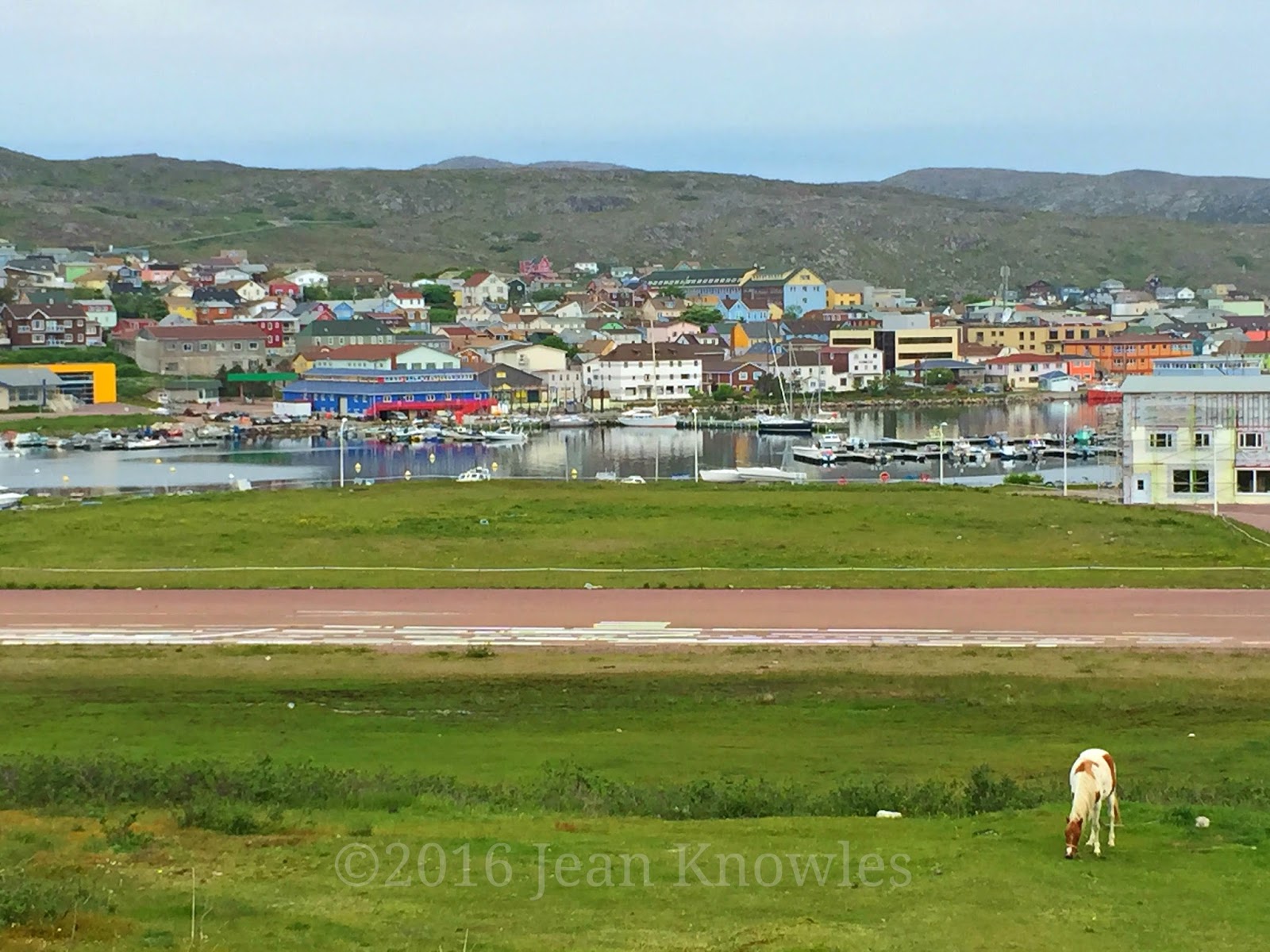
St. Pierre & Miquelon -- a true taste of Europe in North America

St. Pierre


Le Café du Chat Luthier
YJust west of Newfoundland's Burin Peninsula lie the islands of St. Pierre and Miquelon, France's last outpost in North America. This overseas collectivity of France has a population of a little over 6000, and is principally made up of two islands, St. Pierre -- more heavily populated and the smaller of the two -- and Miquelon-Langlade. A third island, Ile-aux-Marins, is located just off the town of St. Pierre and is no longer occupied. The islands lie a short ferry ride from the port of Fortune, Newfoundland and Labrador, or can be reached by air from Halifax, Montreal and St. John's; travel between St. Pierre and Miquelon can be accomplished by air or by local passenger ferry. The islands are also a popular stop for cruise ships both large and small; a great way to visit is on an expedition cruise like those offered by Adventure Canada; I first found my way here on their Newfoundland Circumnavigation, and will return in 2016 on their Mighty St. Lawrence cruise.


Miquelon
The two islands have distinctly different personalities; St. Pierre has a more cosmopolitan feel despite its small size, with restaurants, hotels and shops ranked along its narrow streets, while Miquelon has a much more rural and relaxed atmosphere. Both islands, though, boast brightly coloured houses and beautiful scenery. Wine shops, patisseries and cafes make for some great culinary experiences -- after all, this is France and the wines and baked goods are legendary. Just like in mainland France, a visit to a small shop will provide plenty of options for a light lunch, including locally produced chevre and fois gras. Remember that even though this is definitely France and locals tend to be very fashionably dressed, a good pair of walking shoes is essential.


Ile-aux-Marins
Tourism information centres can be found in both towns, and local sightseeing tours by van can be arranged. A water taxi to Ile-aux-Marins makes for an interesting addition; the island is used as a summer home by some local residents, and historic and cultural displays can be found there. The heritage of the islands' residents is varied; on Miquelon there are many descendants of the Acadians, expelled from New France by the British in 1755, and many islanders also trace their ancestry to the Basque region. Local residents are friendly and most speak excellent English; if you speak French this is a great opportunity to put it to use, but don't hesitate to go because of a language barrier -- you'll get along just fine in English.


Lobster on the menu!
St. Pierre boasts several very comfortable hotels in its central district, while Miquelon has bed and breakfast accommodations. Information on transportation to the islands and on local activities and culture can be found here. Currency is the Euro; both St. Pierre and Miquelon have banking machines where cash can be purchased, and credit cards are widely accepted.
See you in St. Pierre and Miquelon!


Sunday, May 12, 2013

I Like Big Boats and I Cannot Lie

I've always loved working boats, both big and small to be honest, and there are few places better suited to someone with a love of such boats than Atlantic Canada. From the sandy shores of Prince Edward Island to the tides of the Bay of Fundy, shared by Nova Scotia and New Brunswick, to the rocky coast of Newfoundland and Labrador, this region has a wealth of boats of all shapes and sizes.


They can be found in small towns and big cities, tied up at wharves, riding at anchor, or moored "on the collar" in small coves whose names don't appear on any map. The unifying thread among all these boats is their utilitarian grace. They're built for work, not for show, but they have an innate beauty that's a bit poignant somehow, as if try as they will, they just can't help being graceful and elegant.


These days their hulls might be fiberglass, metal or even concrete, but there was a time when every one of them had been built from wood in a local boat shop. Examples of those older wooden boats can still be found if you're willing to look; they might be housed in museums where they're carefully studied for their lines, hauled up on the shore and falling into ruin, or -- in some rare cases -- lovingly patched and mended and still afloat after seventy-five or a hundred years of plying the North Atlantic.


I particularly like those parts of the region where there's a lot of individuality expressed in the colours of the boats; those bright reds and yellows and blues and greens add cheer to a foggy day, and from a practical standpoint of those who wait on shore, it's a lot easier to recognize the boat you're looking for when it rounds the headland making for home. Although today's navigational and safety equipment have reduced the hazards, fishing is still a dangerous way to make a living; here's wishing safe home to all those boats, and to those who travel in them.


Monday, April 29, 2013

Shelburne's Historic Waterfront


The town of Shelburne, on Nova Scotia's scenic South Shore, was one of several communities that were destinations for the United Empire Loyalists who fled the United States during and after the American Revolution, from 1775 to 1812. Known in the U.S. as Tories, they had remained loyal to Britain and had not supported the efforts of the revolutionaries, sometimes actively opposing them. On May 4 of 1783, ships carrying 3073 Loyalists from New York anchored in the harbour of what was then known as Port Roseway, dramatically changing the course of southwestern Nova Scotia's history.


Prior to their landing, the entire territory of Nova Scotia, which then included the present-day province of New Brunswick, had a population of less than 20,000.  By the end of 1783, over 35,000 Loyalists had arrived, overwhelming both the limited infrastructure and the ability of the government in Halifax to cope with the arrivals.


In July of 1783, the name of Port Roseway was changed to Shelburne to honour Lord Shelburne, Secretary of State for the colonies who had served briefly as Britain's Prime Minister in 1782.


By 1784, the population of Shelburne had swelled to over 10,000 -- the largest town in British North America and more than twice the size of Halifax. Eventually most of these Loyalists either returned to the United States as the political climate became less hostile, or moved on to other areas of Canada. They left behind a carefully laid-out town with streets named after members of the Royal Family, and a number of handsome and well-constructed homes and businesses. Today, Shelburne provides an interesting stop for the cultural explorer, with its cluster of museums and restored buildings. Shown here, from the top, are the Shelburne County Museum, the Ross-Thomson House, the Old Dory Shop Museum, and the impressive Cox's Warehouse, its cupola and spire added for the filming of The Scarlet Letter in 1995. 


Sunday, March 24, 2013

Oh, Bonavista!

Newfoundland and Labrador seems to have more than its fair share of beautiful little towns and villages, but one of the most striking is Bonavista. Located at the tip of the Bonavista Peninsula, less than two hours north of the Trans Canada Highway at Clarenville, the town sprawls over 31 square km (12 sq. mi.), much of it mixed residential and commercial. Its busy harbour, protected by a breakwater, is used not only by local fishing boats but by pleasure craft as well -- it's well sheltered, making for some wonderfully scenic reflections. Located at the edge of the harbour is Ryan Premises National Historic Site , a group of restored fish processing and storage buildings that provide an excellent look at the history of the town and the fishery that drove its economy. 
A short distance away at the tip of the cape lies the historic Cape Bonavista Lighthouse with its distinctive red and white paint pattern. From the cliffs here, it's possible to see feeding whales in summer, or observe nesting puffins at close range.
The rest of the Bonavista Peninsula is as welcoming and as scenic as the town itself -- places like Trinity, Port Rexton, Amherst Cove, Spillar's Cove, Keels, Red Cliff and Plate Cove are waiting to be explored!

Monday, March 18, 2013

Bringing Nature a Step Closer

In 1978, the Government of Newfoundland and Labrador established the Salmonier Nature Park in an inland area less than an hour's drive from St. John's, initially as an environmental education centre. Over the years, though, its function has shifted somewhat; it's now an attraction for visitors to the area as well as a wildlife rehabilitation, research and environmental monitoring station. According to the province's Department of Environment and Conservation, Parks and Natural Areas Division, "The mission of Salmonier Nature Park is to provide exemplary learning opportunities and visitor experiences that connect people with the natural communities of Newfoundland and Labrador. These experiences must encourage a better understanding of and contribute to a sustainable future for people, wildlife and the environment on which they depend."


A boardwalk winds through the park, past enclosures that house a number of native wildlife species, some from the Island of Newfoundland and others that occur naturally only in the province's mainland portion, Labrador. The main focus of the park remains on environmental education, with school visits an important part of the park's mandate. It's an excellent place to get a closer look at some of Newfoundland and Labrador's native wildlife in a non-commercial setting, and an added attraction is the fact that the park's woodland location is home to many species of birds. Many of the animals on site come from the park's wildlife rehabilitation program; if possible, they will be returned to the wild.  If that is impossible, they become a permanent part of the park's on-site educational programming.


There is also a breeding program for the Newfoundland Pine Marten. The interpretation site, though, is only a small portion of the park, covering some 40 hectares (just under 100 acres). The entire park encompasses some 1415 hectares, or approximately 5.5 square miles, abutting on the Avalon Wilderness Reserve, and is home to 84 species of birds, 15 species of mammals and over 170 species of vascular plants. A walk along the boardwalk provides ideal viewing opportunities for many of these species, like the snowy owl (Bubo scandiacus), Canadian lynx (Lynx canadensis) and arctic fox (Vulpes lagopus) seen here, so it's an interesting stop for those with an interest in photography or birding.

Wednesday, February 27, 2013

Experiencing the Moment

 For a long time, travel was a popular pastime for those who wanted to see the different, the unusual or the exotic; today, for more and more travellers, it's more about experiencing than just seeing.  Many of us now want to engage all five senses; we don't want the same food, climate or activities we'd find at home, we want something new and different and whenever possible, unique to the place we're visiting. We also like the idea that our travels are benefiting local people in their communities, and that we're meeting and interacting with local residents beyond the rudimentary exchanges found in restaurant or hotel service. 

We're the experiential travellers, and we're the face of travel in the future.  Gone are the "Grand Tour" days when tourists sat removed from their surroundings and simply observed. Today's travellers roll up their sleeves and get involved, both physically and intellectually, with what's around them. It's a new and truly engaged way to travel, and it's had a huge and positive impact on people in the areas we travel to. Perhaps the most interesting aspect of this shift is that it's making the whole process more interesting -- and memorable -- for the people in those destination areas, too. 

Local experts are now engaging with travellers in a way they weren't able to before: there's more time to get to know visitors, and shared experiences can form the basis of genuine interest and friendship. I'm not talking about visitors and local operators singing an endless chorus of "Kumbaya", but there's far more opportunity for them to interact in such a way that encourages long-term contact if it's what both parties want, especially with the ease of communication through email, social networking and Skype.

Travellers today experience the wonders of their destination: the smell of sun-drenched fir trees along a woodland trail; the crisp, cool touch of the breeze blowing past an iceberg; the taste of fresh bread straight from a brick oven, the sound of a foghorn across the water, or the electrifying experience of looking a humpback whale in the eye.