Showing posts with label Nature. Show all posts

Wednesday, May 25, 2016

Among the Tall Pines

Early rhododendrons

In Milton, Nova Scotia, just outside the town of Liverpool, there's a riverside park that is one of the area's natural treasures. Pine Grove Park was established by the Bowater Mersey Paper Company in 1987 to celebrate Queen's County being named as the Forestry Capital of Canada for that year. In the winter of 2012 it was turned over to the residents of the county.


Tall pines along the trail


With 1.6 km (one mile) of looping trails, a swimming beach, toilet facilities and a picnic area, it's a pleasant recreational park. In spring and early summer, though, the park is ablaze with blossoms: rhododendrons, azaleas, magnolias and other flowers are abundant and several woodland glade are perfect habitat for pink lady slipper orchids. Many of the flowering trees and shrubs were selected and donated by retired naval captain Richard Steele, an Order of Canada recipient known as "Captain Rhododendron".


Soft pink rhododendron blossoms


The Mersey River flows past Pine Grove Park, and provides nesting areas for teal and black duck. The winding trails make a marvelous place to break up a long drive with a peaceful walk through the tall pines. The park is just minutes from Nova Scotia Route 103 at Exit 19 and is well worth a stop if you're in the area.


Mersey River

Tuesday, May 17, 2016

It's puffin time again!

Puffin on Gull Island, Witless Bay
It's that time of year again -- the puffins and other seabirds have returned to their colonies around the coasts of Atlantic Canada and Maine. There are many places around the region to see these small, sturdy birds, but two locations stand out: the Witless Bay Ecological Reserve for sheer numbers, and the Puffin Island at Elliston for land-based observation.


The Witless Bay Ecological Reserve lies south of St. John's, Newfoundland and Labrador. Witless Bay takes its name from an early family of settlers, the Whittles family; over the years the name has been corrupted to its present form. The four islands of the reserve lie just off the shore, from north to south they are Gull Island, Green Island, Great Island, and the fancifully named Peepee Island, whose name is said to be from the distinctive aroma that wafts from it in summer.


Typical "puffin weather" at Elliston
There are boat tours that allow for a closer approach to the islands; to protect the bird life, only those operators granted special permits are allowed to travel through the reserve. Bay Bulls is the primary starting point for these excursions, while operators can also be found in the town of Witless Bay and in Mobile, just to the south. All Witless Bay photos in this post are thanks to Captain Wayne's Marine Excursions of Bay Bulls. Other operators can be found here.


Puffins are true pelagics: they land on these rocky islands solely to mate and rear their young, spending the remainder of the year on the open sea. They burrow into the dirt of the island, or on rockier sites use narrow clefts in the rock for burrows. The pairs bond for life, returning to the same burrow year after year, although "divorces" are said to occur if one mate is a less-than-stellar provider. They're not the only seabirds that nest in the Reserve; there are also black-legged kittiwakes, common and thick-billed murres, black guillemots, and huge numbers of Leach's storm petrels among others.


Burrow entrance
Elliston, located on the Bonavista Peninsula, is the self-styled Root Cellar Capital of North America due to the large number of these storage structures that can be found there. Just outside the community is a headland accessed by a rocky trail that leads to a viewing point overlooking a small island that houses a breeding colony of puffins. The unusual thing about this spot is that when the weather and wind are right (often damp weather and a southeast wind) the puffins will land near the viewing area on the headland itself. This makes for some incredible up-close viewing experiences.

The puffins will be around until late August, with a few lingering into September, so there's plenty of opportunity for a good look during the summer months. Happy viewing!

Friday, May 06, 2016

Reflecting on Nature


While sorting through a few archived images for a project, I was struck with how many of them had one striking feature in common: reflections. Whether in sea water, glass or even wet pavement, this simple phenomenon has the power to captivate. I have to admit that I'm pretty much addicted to them. Sometimes the morning sun's low angle sets off a perfect combination of elements to create an unforgettable image.


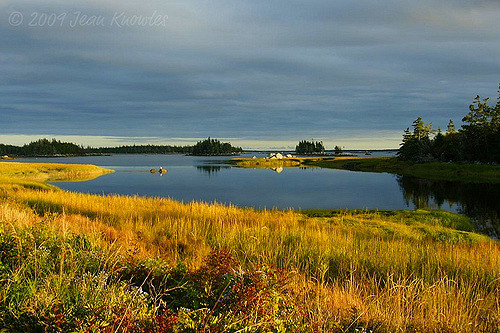
Sometimes it's the evening light that does it, turning marsh grass to gold, deepening the colours of the blue-grey clouds and painting the granite rocks a stark white, like this scene in Atwood's Brook, NS.


Blue Rocks, Nova Scotia, is a picturesque spot at any time, but the touch of the early morning sun on the golden shades of autumn can make it even more beautiful.


Evening's soft rose tones on a winter day can create a Rorschach sunset around the inshore islands. This is another scene from Atwood's Brook, NS.


A few sanderlings scouting for food at the water's edge make for some striking reflections in the wet sand of Daniel's Head Beach, Cape Sable Island, NS.

Monday, April 18, 2016

The Birds of the Open Sea

Newfoundland and Labrador is a prime location to see birds that normally make their home on the open sea -- the pelagics. The word is defined as "of or relating to the open sea" and in birding it refers to those species that spend most of the year on the open water and make their way to land only for the breeding season and to rear their young. They're fascinating, hardy birds and there are many varieties of them. Here are a few that can be found along the coastline of Canada's easternmost province:


Atlantic puffin
Atlantic Puffin (Fratercula arctica)
Nicknamed the Clown of the Sea or the Sea Parrot, this member of the alcid family can be found in huge numbers around Newfoundland and Labrador. Not satisfied to host the largest colony of this seabird in North America, the province also boast the next five largest colonies as well! Puffins aren't great fliers, and are far more comfortable in the water than in the air or on land. Their most-favoured nesting sites are islands that are naturally protected from most land-based predators, although still have to contend with occasional forays by gulls, hawks and even eagles. Puffins dig burrows into the soft soil of the islands or nest in clefts in the rock. The best viewing areas for puffins are from the boat tours serving the Witless Bay Ecological Reserve just south of St. John's, and Elliston's Puffin Island on the Bonavista Peninsula where the puffin-watching is land-based. The image at right was taken on an evening cruise with Captain Wayne's Marine Excursions in Bay Bulls.


Razorbill
Razorbill (Alca torda)
These elegant-looking birds with their black tuxedos and pinstriped bills are also alcids. Like many other pelagics they are colonial, tending to nest in large groups. They are less common than puffins or murres in this region, but a trip to the islands of the Witless Bay Ecological Reserve in season is bound to bring a sighting or two. Auks like these mate for life, and each pair of adults produces only one egg per year; if that egg is lost another may be laid but in all likelihood won't be viable since the hatch is timed to coincide with the run of caplin (or capelin), a member of the smelt family that is the primary food source for most nesting seabirds along Newfoundland's coasts. When the breeding season is over, these birds head out to sea and spend the remainder of the year offshore, as far south as New Jersey and occasionally Virginia.


Common murre nesting colony
Common Murre (Uria aalge)
This abundant bird is penguin-like in appearance, its resemblance to those southern-hemisphere birds the result of convergent evolution, or the gradual evolving of similar features in unrelated species as a result of living in similar environments. Unlike penguins, though, most alcids are capable of flight -- the exception was the great auk, extinct since the mid-19th Century, which was once found here in huge numbers. British birders know this species as the common guillemot.


Thick-billed murre
Thick-billed Murre (Uria lomvia)
Known to British birders as BrĂ¼nnich's guillemot, the thick-billed murre is distinguished from its common cousin by the white line along the side of the bill, which is slightly thicker than that of the common murre. Both species lay their eggs directly on the rocks instead of building nests, and the eggs are conical in shape so they roll in a tight circle -- a necessity when they are laid on narrow rock ledges high above the sea. Common and thick-billed murres are superb swimmers and divers, using their wings to "fly" through the water to depths of more than 100 metres. 


Juvenile black-legged kittiwakes
Black-legged Kittiwake (Rissa tridactyla)
The kittiwake is a pelagic gull that nests on rock ledges. Unlike the alcids, these birds may lay two or even three eggs. They are graceful and agile fliers, and their name comes from a phonetic rendering of their call. In Newfoundland they are sometimes referred to as the tickle-ace or tickle-ass, from their habit of flying close behind other birds and harassing them by nipping at their tail feathers as they carry prey, in an attempt to get them to drop it; this behaviour of stealing food from other birds is called kleptoparisitism. 


Northern fulmars
Northern Fulmar (Fulmarus glacialis)
This handsome bird is found mostly in subarctic regions of the North Atlantic. While it looks like a gull it is related to both petrels and albatrosses, evidenced by the structure of its beak, which has evolved to help it remove salt from its system.  Its wingbeats are stiffer than those of a gull and it can be recognized by the way it glides, and by the dark spot in front of the eye. When threatened, the fulmar has a rather disconcerting habit of projectile vomiting on the intruder, a very effective deterrent indeed.


Northern gannet feeding young
Northern Gannet (Morus bassanus)
This member of the booby family nests in colonies of bare rock, building a nest from grasses, seaweed and found materials like netting twine. The adults mate for life and raise a single chick each year, remaining in the nesting area until late in the autumn. A prime viewing area for this graceful species is the Cape St. Mary's Ecological Reserve near St. Brides, where they nest on a remarkable sandstone seastack that is only about ten metres away from the viewing area, reached by a 1-km-long trail from a well-designed interpretation centre.


Greater shearwater
Greater Shearwater (Ardenna gravis, formerly Puffinus gravis)
While it breeds in distant Tristan da Cunha in the South Atlantic, the shearwater is a frequent summer visitor to the shores of Newfoundland, especially when a cold wind blows the fog in off the sea. Its name comes from the bird's gliding flight just above the water's surface. The darker sooty shearwater can also be found here, and there is a small breeding population of of about 350 Manx shearwaters (Puffinus puffinus) off the coast of the Burin Peninsula.


Thursday, March 24, 2016

St. Anthony -- In the Footsteps of Grenfell

St. Anthony Sunrise
Travel down the Great Northern Peninsula (yes, north is "down" here) and you'll find yourself in St. Anthony, the outpost at the end of the road. To be truthful, the road has only been here for sixty years or so; like many small towns around the coast of Newfoundland, this port was once served only by water, as a stop on the coastal boats that plied the island's shores. This community of roughly 2500 people serves as a supply centre for the surrounding area, so there are grocery stores, hotels, restaurants and many other services, but it's St. Anthony's history that makes it remarkable.


Sun Porch, Grenfell House
In 1892, a young and determined doctor arrived here from England; this was then an English colony, and the Royal National Mission to Deep Sea Fishermen carried out visits to bring medical care to the people of northern Newfoundland and the Labrador coast, and Dr. Wilfred Grenfell was here to do what he could for his fellow man. He was ahead of his time in realizing that social conditions, nutrition and physical activity were all part of overall health, and he went on to form an organization to raise funds to provide health services in the region. His legacy lives on the present-day health care system serving St. Anthony and the remote coastal communities of Labrador. The International Grenfell Association's headquarters were in St. Anthony and it was here that Grenfell made his home. One of my own favourite aspects of his house is the warm and welcoming sun room that wraps around it.


The View from Tea House Hill
Today, the Grenfell Historic Properties provide an opportunity to learn about this remarkable man through the Grenfell Interpretation Centre, the restored house, and the Tea House Hill Trail which provides wonderful views of the surrounding area. From the Grenfell Dock, Northland Discovery Boat Tours provide whale-watching and iceberg-viewing opportunities with expert interpretation. This area boasts one of the longest iceberg seasons in Newfoundland and Labrador, as well as frequent sightings of humpback whales and dolphins and even occasional pods of killer whales!

Iceberg Near St. Anthony
St. Anthony's harbour is a busy one, with a fleet of fishing boats, processing plants, and a large wharf that accommodates vessels carrying freight. Several times a summer, small expedition cruise ships visit to take in the sights in the area.


Wednesday, May 22, 2013

First Visit to the Cape


The first spring visit to Cape St. Mary's always reminds me what a wonderful and varied place this is. Known primarily as a nesting site for thousands of northern gannets, it also provides a feeding ground for bald eagles and ravens, typical habitat for savannah sparrows and horned larks, and forms part of the range of the southern Avalon caribou herd.


I arrived in the early morning and started down the trail from the visitor centre; visible even from this distance, a juvenile bald eagle (Haliaeetus leucocephalus) was circling high above the cove, the sun highlighting its mottled colours.


Another few minutes of walking brought me to the main point near Bird Rock, the centre of the gannet (Morus bassanus) nesting area.  This point overlooks the rock, and in another month it will be possible to spot the first of the year's chicks, guarded by their protective parents. Now, though, it's only adult birds that are visible, soaring overheard or returning to the nesting sites with seaweed or twine for nest repairs.


Returning along the trail, I heard the unmistakable trill of a savannah sparrow (Passerculus sandwichensis) from just ahead. There it was, perched on one of the stakes that mark the trail.


The day's real treat, though, came in the form of a handful of caribou (Rangifer tarandus) trotting across the Eastern Hyper-oceanic Barrens. They were a hundred metres away, and seemed unconcerned at my presence. They'll soon begin to shed their pale winter coats, taking on a darker, sleeker look for summer. It will be fascinating to watch the changes that take place here at the Cape between now and October.

Saturday, March 30, 2013

Recognizing the Value of Nature's Wonders


The Ecological Reserves at Witless Bay and Cape St. Mary's and Baccalieu Island are natural treasures on Newfoundland and Labrador's Avalon Peninsula. They're linked in more than geography, though; they're all under the oversight of the Parks and Natural Areas Division, Department of Environment and Conservation and they're very precious places indeed. They serve as nesting areas for a number of seabird species and among them they contain the world's largest and second-largest Leach's storm petrel breeding colonies along with North America's largest Atlantic puffin colony, and North America's most accessible northern gannet nesting area. Cape St. Mary's is the nesting site for roughly 70,000 nesting pairs of birds, the Witless Bay Reserve houses 620,000 pairs of Leach's storm petrels and 260,000 pairs of Atlantic puffins, while Baccalieu Island hosts an incredible 3,360,000 pairs of these petrels along with a diverse range of other seabirds.


These birds aren't here just for the scenery, although it's admittedly beautiful. They're here because the islands and coastal cliffs are composed of a variety of nesting options from earth for digging burrows to narrow rocky ledges. Their fecundity is immense; 3.36 million pairs of Leach's storm petrels, or over 6.7 million individual birds, at roughly 13 oz. (380 grams) per bird adds up to nearly 5.5 million pounds of petrels. That's not counting the year's hatch of nestlings! The nesting areas are situated near immediate sources of food, ranging from plankton and krill to massive schools of caplin; it takes a vast quantity of marine life to sustain this population, and the nesting season is linked to the arrival of these vital food sources; it's all part of the intricate balance of seabird life.

These reserves are special places that truly are among the world's wonders. They deserve protection, preservation, and recognition.