Showing posts with label Fishing. Show all posts

Friday, March 08, 2013

The Reason for All that Red

One of the striking features of the Atlantic Canadian landscape is the abundance of red buildings, especially barns, outbuildings and sheds, in the vernacular architecture. There's an excellent reason for this, deeply rooted in the heritage of the region: because of the huge deposits of iron in the area, the iron oxides used for this handsome range of colours occur naturally here. It's ochre (or ocher), which has been used as a pigment for thousands of years.


 Technically, ochre is defined as "any of various natural earths containing ferric oxide, silica, and alumina: used as yellow or red pigments" and the yellow shades show up, too, but it's definitely the reds that dominate. Place-names all over the region reflect this; it's easy to find places called Ochre Pit Cove or Ochre Hill, and there are also place-names that refer to red, signalling the rusty tones that oxidizing iron can give the soil. The naturally-occurring pigment, sometimes treated by burning, was mixed with linseed oil in many places, but here in Atlantic Canada it was almost universally mixed with ingredients that were much more readily available locally: seal oil or fish liver oil. Oral tradition has it that the brighter reds were obtained with seal oil, while fish oils gave a darker, reddish-brown tone.

Use of red ochre in Newfoundland, though, goes back to a time long before the first Europeans arrived; the island's native population, the Beothuks, gathered ochre and used it to paint canoes and other artifacts and even their bodies. The Beothuk culture, ancestrally related to the Mi'kmaq, emerged around AD 1500, ending in 1829 with the death of the last surviving Beothuk, Shanawdithit.

Today, the red paint used often comes from commercial pigments, but the resulting look is very much a part of local tradition and culture.


Thursday, February 28, 2013

"We went because they needed answers"

On February 17, 2013, the fishing boat Miss Ally, with five men aboard, was lost in a storm off the South Shore of Nova Scotia. The hull of the craft was sighted, but searchers chose not to examine it right away. At the request of the families of those on board, a full day before "official" crews examined the hull of the Miss Ally, four divers from Shelburne County had been to the hull to provide answers for those grieving families. Please follow this link to look into the faces of these true heroes of the community. Their heartfelt gift was to help in the only way they could.


Wednesday, February 20, 2013

Days of Sorrow


It's impossible to live in a small, closely-knit coastal community and not feel the effects of harrowing loss. Southwestern Nova Scotia is experiencing such sorrow, with the sudden and tragic loss of the halibut-fishing boat Miss Ally and the five young men on board.  The skipper was Katlin Nickerson of Wood's Harbour, and with him on the voyage were Joel Hopkins, Cole Nickerson, and Tyson Townsend, all of Wood's Harbour as well, and Billy Jack Hatfield from nearby Cape Sable Island.  The five set out in the 14-metre Cape Islander on February 12, 2013 to pursue the winter halibut fishery, which takes place in during the worst of winter's storms and gales. After the boat's emergency beacon was activated on Sunday night, searchers were hampered by sea conditions that included wind, freezing spray and waves of 10 metres or more. Several aircraft, two Coast Guard vessels and various merchant vessels took part in the search, but the search area was broad and the sea conditions far from ideal. The fishing communities of Southwestern Nova Scotia waited, tension thick in the air, while the search continued; nighttime brought a gesture of solidarity throughout the region as homes up and down the shore left a light on through the night to speed the men's safe return. It was all to no avail, though, as the search was called off on Tuesday evening.   In addition to other family members, the captain and crew of the Miss Ally leave behind a total of six children. Hearts are heavy along the shore today.

Wednesday, February 29, 2012

Mornings in Blue Rocks

About four kilometres southeast of Lunenburg, is the little community of Blue Rocks, Nova Scotia. Watch out for white-tailed deer on the drive -- they're plentiful out here. A handful of houses hugs the shoreline here, along with a scattering of wharves and fishing stations. There's something wonderful and almost magical about the light in Blue Rocks, especially in early morning and evening.

There's not much road to cover here, but every turn reveals a new and striking scene. Low tide reveals rockweed on the bluish rocks that give the village its name; the light catches the seaweed turning it to deep gold. There's more gold in the weathered wood of fishing stages, the tidy shingles of sheds and barns, and the worn timbers of wharves. Continued exploration along the coastal road will bring still more scenes that are begging to be photographed or painted by someone with an appreciative eye. There are working fishing boats, abandoned boats, punts and skiffs and dories powered by outboards or by main strength on the oars. There are lobster traps of wood or wire stacked by sheds in the off season, their brightly coloured buoys and coiled ropes neatly tucked inside.

In the stillness of early morning, deer wander down to the water's edge and coyotes' howls can be heard in the distance. Perfect reflections shimmer in the smooth surface of the coves, intensifying the colours of the sky and shore. As in many small communities in Atlantic Canada, many of the houses here belong to "summer people" from Halifax or farther afield. There are still plenty of year-round dwellers, though, so lights are on in their kitchens, where the first of the day's cups of tea are being brewed and sipped.

There's certainly no shortage of interest in this little spot, even without venturing farther down the road to Stonehurst, although it's certainly well worth the trip with its Maritime vernacular architecture and expanses of glacial paving, evidence of the times when this whole region was covered with ice during the Wisconsinan Glaciation 10,000 years ago.

When it's time to head back to Lunenburg, it's essential to make the trip at mealtime since it would be a shame to leave town without a visit to the Knot Pub for fish and chips or a Knot burger, made from locally produced Lunenburg sausage.


Friday, February 17, 2012

The Untold Stories

I have an admitted love for working boats, but I'm fascinated with boats that have been left behind; boats that have been abandoned in favor of replacements, or left on the beach because they've simply outlived their usefulness. In my eyes, they've all got a story to tell after a lifetime of hard work. It seems right to show them a bit of respect by capturing the wistfulness or melancholy of their look. From the proper angle, the old boat rotting in a field far from the water's edge still shows the elegant lines that once set it apart from others. The workmanship is still there in every
joint, accentuated by the effects of weathering. For as long as there have been boats along these shores, it's been possible to find derelicts. Since the announcement of the cod moratorium in 1992 and the subsequent restructuring of the fishery, many small inshore boats have fallen into disuse and lie where they were dragged at the end of their last season. Outmigration from Atlantic Canada to other regions of the country or to the U.S. has combined with a population shift from rural to urban centres to leave boats high and dry and houses empty; when the community is shrinking there's no one to sell a boat to, or a house for that matter.
Our schools seem to emphasize skills that are useful for getting an office job, not making a rural livelihood. Our economic focus has shifted from the fishery to mining, manufacture, large-scale commerce and tourism, yet our lives and psyches remain firmly tied to the sea and to our seafaring past. The provinces of Nova Scotia, New Brunswick and Prince Edward Island are called the Maritimes, meaning situated by the sea. They've been a political and economic bloc at least since the eighteenth century. Add Newfoundland, Canada's newest province, to the mix and the region becomes Atlantic Canada, taking its very name from the ocean on our doorstep.

This is a region of incredible beauty and fascinating history; it has struggled when other areas prospered, and thrived when other parts of the country faced hard times. It dances to its own rhythm, and it will persevere. These derelict boats serve as a reminder of its close ties to the sea, and the pride those ties engendered. Pride in our heritage is part of that rhythm; the rhythm of the waves, of the tides, and of our lives.


Tuesday, January 17, 2012

Port Union's decaying heritage, and hope for rebuilding

Port Union, Trinity Bay North, is North America's only union-built town. It began in a flurry of hope and promise in 1916, a project of the Fishermen's Protective Union spearheaded by Sir William Ford Coaker, union leader and visionary. The organization was established to break the merchants' stranglehold not only on salt fish prices but on all aspects of the fishery and trade. By the 1920s the community included the publishing offices of The Fishermen's Advocate, the union's weekly newspaper, and Congress Hall, site of the union's annual convention, a hotel, a school, a woodworking factory and a power generating plant. A devastating fire in the 1940s renewed interest and efforts behind the community, as the damaged buildings were replaced. Over the years, though, interest in the union waned and the bustling community began to slow down and fall into disrepair. By the 1990s, the cod moratorium brought an end to the activities of the FPU and the buildings were in a state of neglect.
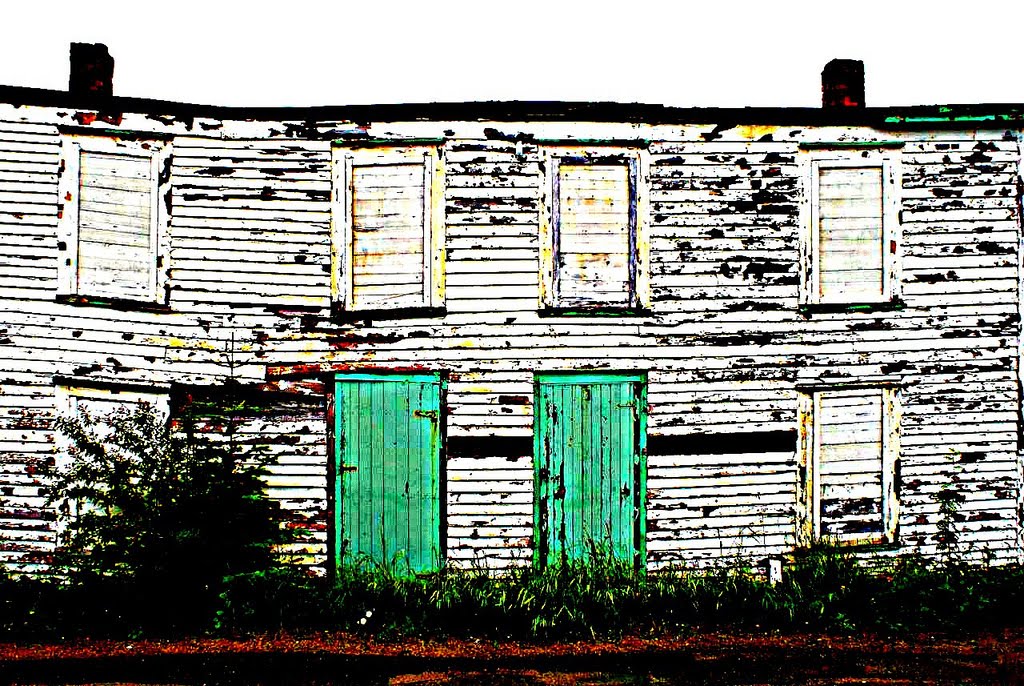
A local group, the Sir William Ford Coaker Heritage Foundation, has been formed to resurrect this historic district of the town, though, and work is under way to restore a portion of the town. It's now possible to tour the site during the summer season. The bulk of the restoration is taking place along the waterfront. Much of the row housing provided for working-class families is in a serious state of disrepair and may be beyond salvaging. The buildings show the years of care that predates this neglect, though, with their many layers of paint from successive "sprucing up". Learn more about the Fishermen's Protective Union and the Heritage Foundation here.