Showing posts with label Avalon Peninsula. Show all posts

Monday, March 04, 2013

Iceberg Season Drifts Into View

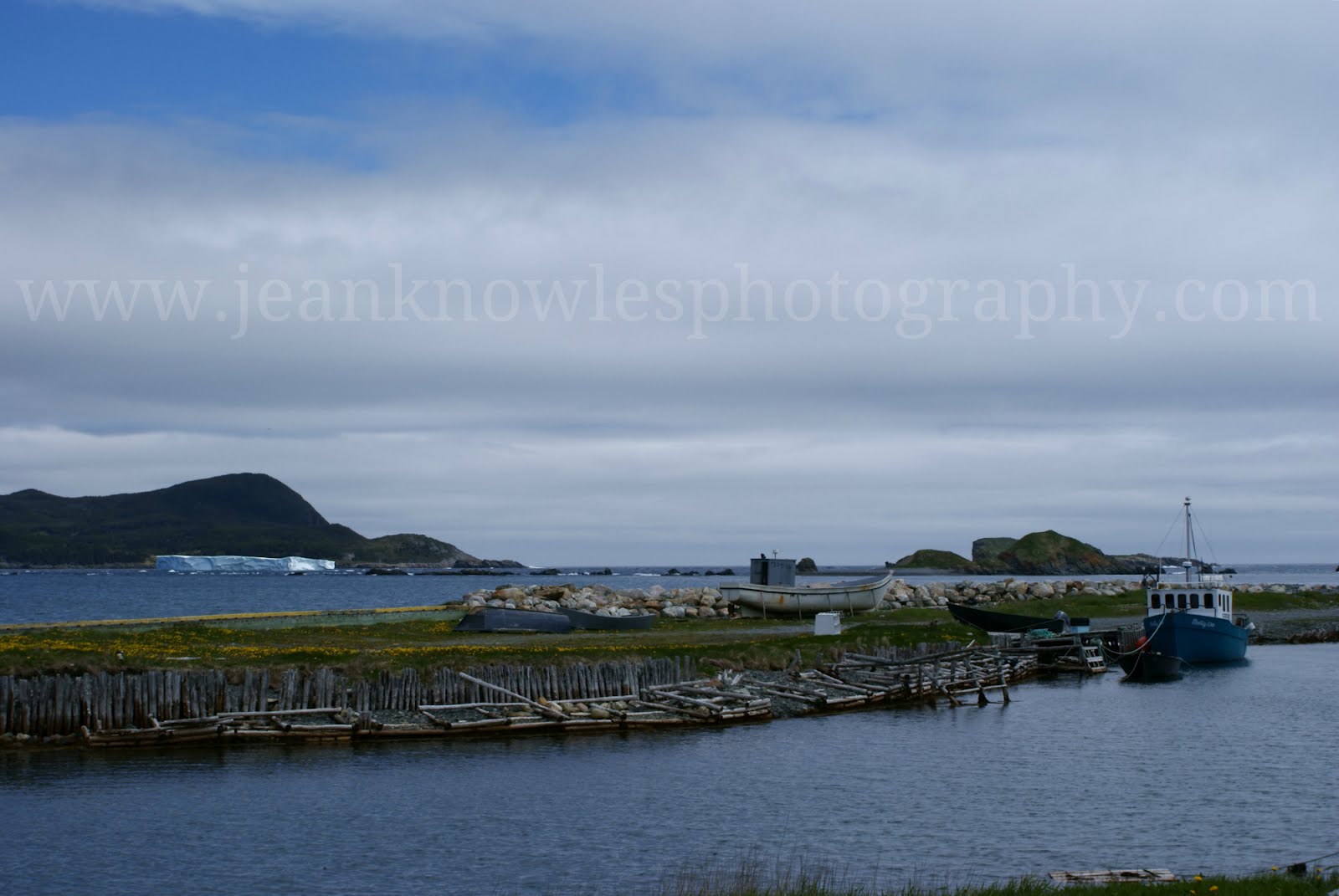
April, May and June are prime iceberg-watching season in Newfoundland and Labrador,since this is the time of year when these northern giants drift south on the Labrador current after spending the winter frozen into the sea ice.  They'll gradually break free as the ice begins to break up, and move with the current to the shores of Labrador and then the island of Newfoundland. Their pace is slow and stately, befitting to the offspring of glaciers, and like most youngsters they move much more quickly than their parents. They move at the speed of the current, getting the occasional boost from favourable breezes if the berg is tall enough to act as a sail. They come in all shapes and sizes, from growlers the size of a cottage to massive,
floating islands of ice like those that calved from Greenland's Petermann Glacier in 2010 and 2012. They heave into view in the distance and inch to the south each day, but changes in wind direction can play tricks: one berg that had grounded on the south side of Bay Bulls (near St. John's) last spring suddenly freed itself drifted out of sight to the north before abruptly changing direction and moving south, ending up in Ferryland by the next morning. Bergs are often at their most spectacular as they begin to break up; the centre of gravity shifts as a result of erosion from sun, wind and water, and suddenly the massive weight of the berg can no longer support itself and a huge section will crack off, or the entire berg will roll and chunks of ice will fly in arcs to the water. It's important to treat these ice giants with respect, but they can certainly provide some wonderful viewing opportunities.

Thursday, February 14, 2013

Window on the Ancient Past

A couple of hours south of St. John's, the community of Portugal Cove South is the gateway to two important sites, Cape Race -- the Marconi station where the last signal from the Titanic was received -- and Mistaken Point, where the fossils of the Ediacaran biota, Earth's oldest complex lifeforms, can be found. This site is a true treasure, considered significant enough to be featured in Sir David Attenbrough's presentation, First Life. You'll see his visit to Mistaken Point at minutes 23:25 to 36:00.  All visitors to the fossil site must be accompanied by trained interpreters; a guided visit takes place each day, starting at the Interpretation Centre for the Mistaken Point Ecological Reserve.  The site is reached on foot, by way of a coastal trail that leads to the sloping
sandstone and mudstone layers that house the deposit. Some 560 to 575 million years ago, this area was at the bottom of a deep ocean, far beyond the level to which light could penetrate. The Mistaken Point Assemblage is made up of over 30 soft-bodied species that existed millions of years before animals developed skeletons.  They were preserved by a series of undersea volcanic eruptions that covered them completely in layers of ash, and eventually the seafloor containing those layers was thrust upward to its present position.  While other deposits of a similar age exist, the grouping of lifeforms at Mistaken Point is unique. This rugged and
often fog-shrouded coastline is now on a list of nine potential UNESCO World Heritage Sites within Canada.

Much of our knowledge of Ediacaran fossils at this remarkable site comes from the research of Dr. Guy Narbonne, Professor and Research Chair in the Department of Geological Sciences and Geological Engineering at Queen's University in Kingston, Ontario.  Dr. Narbonne is a world-renowned specialist in the origin of animals, whose description of the unusual fractal nature of the Ediacaran physiology was hailed as one of the top 100 science discoveries of 2004.

The fossil beds are located at the edge of the Eastern Hyper-oceanic Barrens ecoregion, noted for its distinctive low-growing vegetation and balsam fir tuckamore.  The walk to the fossil beds is approximately 45 minutes in each direction over rolling and uneven ground, with two stream crossings.  Be prepared for the cool, damp weather that's common to the area.


Tuesday, February 05, 2013

A Different Season

Although summer is the season that draws the most visitors to Newfoundland and Labrador, each region of the province has its own intriguing options for every season of the year; for winter sports like skiing, snowboarding and snowmobiling, central and western Newfoundland as well as Labrador, with its annual Winter Games are perfect destination areas. The maritime climate of theSt. John's in winter shows a different face from the one it displays in summer, but it's equally beautiful and there are plenty of interesting things to see and do. It's true that St. John's gets some
wintry weather, but it seems as though there's a sapphire blue sky for every steely grey one. This is the time of year when cultural events abound. Folk Night, produced by the Newfoundland and Labrador Folk Arts Society, is a weekly event that brings the best of the province's traditional music to the stage of the Ship Pub in central St. John's. The artists shown here are noted musicians Fergus O'Byrne and Fergus Brown-O'Byrne..

The Arts and Culture Centre
, located on the campus of Memorial University, features a wide range
of performances from theatre to dance to symphony, with pop, country and folk acts thrown in for good measure. With a total capacity of just over a thousand, it's a formal yet relatively intimate venue and there's literally not a bad seat in the house. Closer to the center of St. John's are the Holy Heart Theatre with a fine and varied roster of acts, and the Resource Centre for the Arts, a well-appointed and truly intimate performance venue located in the historic Longshoremen’s Protective Union (or LSPU) Hall.

Be sure your stay includes a Friday night, the busiest night in the vibrant music scene that keeps St. John`s hopping. There`s music of almost every style at George Street pubs like the Fat Cat, O`Reilly`s, Sundance, Trapper John`s and more, but one of the outstanding venues is Erin`s Pub, located on Water Street just a couple of blocks from the busy George Street strip, where a traditional instrumental session rocks the house in the early evening -- it makes a great starting point for a downtown pub crawl, but be warned: you just might find yourself wanting to extend your stay in St. John`s!

Tuesday, August 14, 2012

A Morning With the Seabirds

You'd definitely have to call it a busman's holiday: on the day following my last Newfoundland Adventure of the 2012 season, I drove to Bay Bulls for a trip with friends. We headed for Captain Wayne's Marine Excursions and boarded the Blackfish 1 for a visit to the Witless Bay Ecological Reserve and a look at the surrounding coastline. After a loop through Island Cove, a look at the sea stacks of Spoon Cove, and a visit to a beautiful sea cave, we struck out for Gull Island, nesting site for thousands of Atlantic puffins, kittiwakes, murres and storm petrels. Light fog was hanging over the area and sea conditions were excellent, with an ocean so calm that the hundreds of birds in the water cast perfect reflections. We travelled slowly alongside Gull Island, pausing to photograph the puffins outside their burrows on the grassy slopes and lounging on the rocks near the water's edge. These photogenic little birds seemed to be in a particularly cooperative mood, posing for us as we slipped past. Although the fledging season is here and many pufflings have already left their burrows, there were still plenty of adults to be seen. There were also many common murres, some
guarding chicks that had not yet fledged. The young birds are ready to leave the nest at about three weeks of age;; unable to fly, they tumble or glide down the cliffs to the water below. Once the chick has fledged, the male parent attends it closely for up two two months as the birds venture out to the open sea. Within about two weeks the young are able to fly. The female stays at the nesting site for an average of two weeks or slightly more. This is the time of year when the
dense concentration of murres on the island begins to thin out.

A little farther south on the island, an unusual sight awaited us: one of this year's black-legged kittiwake chicks exhibited a condition called isabellism, a dilution of melanin, the pigment that colours the bird's black feathers and legs. In isabellan birds, one of the two types of melanin, Eumelanin and Phaeomelanin, is missing, resulting in a bird that shows a pale tan colouration
in areas that are normally dark.

As we reached the southern end of Gull Island and headed for open water, we found that the fog and onshore wind had brought a large number of greater shearwaters, birds that are usually found far at sea. These birds nest in Tristan da Cunha, a remote group of volcanic islands in the South Atlantic. One of these curious birds swam up to the boat to investigate us, providing a great opportunity for a close-up shot. From our shearwater encounter, we headed north to view the area's beautiful coastline; more about that in a later post.

Thursday, August 02, 2012

The Summer of the Whales

It's been an extremely busy summer, and one filled with remarkable experiences. For tour boat operators and land-based whale watchers alike in eastern Newfoundland, it's been the Summer of the Whales -- a summer of flipper-waving, spyhopping, tail-lobbing, barrel-rolling, breaching excitement. In a word, wow!

The whales have been cavorting around the Avalon Peninsula and in Bonavista and Trinity Bays,
and each week's adventures around those areas with Wildland Tours have been enriched by memorable encounters with humpbacks. It seems as though every trip with Sea of Whales Adventures, O'Brien's Boat Tours, or Captain Wayne's Marine Excursions has produced a bumper crop of sightings and photo opportunities, and the sightings just keep on coming. The weather has been outstanding, too, with brilliant sunshine, warm temperatures and
evenings filled with golden light -- all the better to record the interaction with the whales. It's early August now, and although the seabird population is beginning to diminish as the birds leave for another season, the whale encounters show no signs of slowing down. I know for certain that it's a great year to be a whale watcher in eastern Newfoundland, and judging by all the cetacean activity going on along our shores, I think it must be a great year to be a whale!


Monday, June 04, 2012

Icebergs, Archaeology and Antlers

Roughly an hour south of St. John's lies the town of Ferryland, site of the Colony of Avalon, established by George Calvert, the first Lord Baltimore. Calvert purchased the land in 1620, and the following year sent out a party of twelve settlers under the leadership of Captain Edward Wynne. Although a year-round settlement was established, when Calvert himself ventured to the area in 1629, he discovered that winters here were much harsher than he had anticipated; he
chose to make another attempt at forming a colony, this time further south -- his heirs founded the first settlement in what is now the State of Maryland. Today the site is open to the public; a small admission charge covers access to a visitor centre with extensive displays of artifacts found during the ongoing archaeological dig. Guided tours acquaint visitors with the buildings unearthed to date, including a cobbled street, various dwellings and outbuildings, and what is
arguably North America's first known "flush" toilet -- the flush mechanism was the ocean tide!

Another hour on the road brought us to the town of Trepassey, where a large, sleek and healthy-looking bull moose grazed in a clearing not far from the road. He cooperatively posed for photos before we moved on across the eastern hyper-oceanic barrens toward St. Vincent's and along the shores of St. Mary's Bay, returning to St. John's for the evening.