Showing posts with label Fog. Show all posts

Wednesday, February 22, 2012

Raindrops and Dewdrops and Dull, Drizzly Days

Living in a part of the world where any season can be marked by rain, drizzle and fog, it's vital to develop an understanding that the weather outside doesn't necessarily have to set the tone for the day. There's much to be said for a foggy day in winter, since it usually means that the weather's taken a mild turn and the snowbanks are about to disappear, or at least show a significant reduction in size. The sun may not be splitting the rocks, but mild weather has its advantages. In spring and fall, the fog can make for some interesting photo opportunities as it seems to soften the edges of the landscape. In June, it's a sure sign that summer's on its way since it's a contrast between the warm temperature of the land the the cold water that create the condition.

In the spirit of embracing the moment, I often take the camera out for a walk on a foggy day to capture its subtle charms. I love the way water droplets collect on lichens and mosses, and the way the moisture darkens the bark of trees and shrubs to provide extra contrast with soft green leaves or bright autumn tones.
I can be just as put off by a downpour as anyone; it's challenging to get as much enjoyment out of a day when the rain's pouring down, but a little light drizzle can be taken in stride.

I have to admit that I love it when tour guests take bad weather in stride. It's what we're getting, we can't change it, so we may as well enjoy what we've got. For that reason I have some very happy memories of those out-of-the-ordinary touring days over the past thirty years or so, when weather could have spoiled our fun but didn't -- days that were enjoyed despite the weather's most determined efforts. Thanks, all you rollers-with-the-punches. You know who you are; you make my job a heck of a lot easier, and you're great fun to be with!


Saturday, January 28, 2012

Embracing the Fog

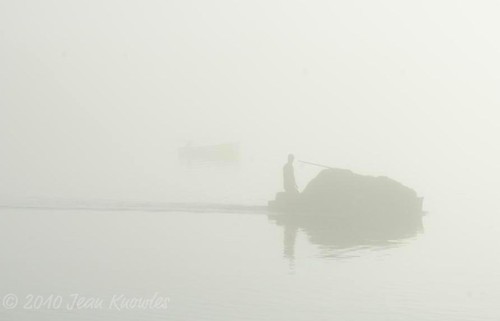
A lifetime of Atlantic Canadian summers have taught me a very important lesson: sometimes there's fog. The scientific explanation, of course, is that the fog is created by the temperature differential between the warm land and the cold sea water. As the summer progresses, foggy days become less frequent because the water is warming up; June, though, is a time when an occasional foggy day just has to be expected. Since it's a natural phenomenon that just can't be controlled by the likes of me, the only thing to do is to find a way to embrace it and appreciate it. By the boatload I know it can be a disappointment to encounter fog at a vacation destination, and I don't particularly want to sound like Pollyanna, but accepting the fact that fog happens can help to take some of the sting out of reduced visibility. In other words, it's good to find some Zen. To me, fog is almost like a living thing; it swirls and sweeps and eddies, forming almost instantly on a changing breeze and disappearing almost as quickly. It creates an air of mystery and seems to change the contours of the familiar. It can form an all-encompassing blanket or drift in wisps on a sunlit shore. It's perhaps at is most playful around icebergs, forming and dissipating almost on a whim. Fogbound My camera is almost always at hand, and foggy days are often the ones when the camera gets the most use. There's something so fleeting and elusive about a bank of fog flowing like a wave over a headland or softening the contours of a rocky outcrop that it's hard to resist the urge to capture its unique and arresting beauty. The fog really is part of the adventure! Pure Newfoundland

Monday, January 23, 2012

Notes from Iceberg Alley

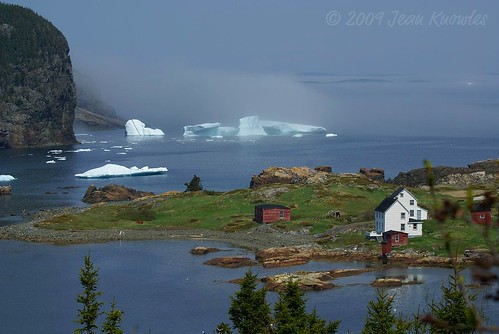
Icebergs. I love the variety of shapes, sizes and colours of these great mountains of ice that drift past Newfoundland's coast in the spring. Most are calved from the glaciers of Greenland, with a few coming from the islands of Canada's eastern Arctic, often spending a year or more reaching the Davis Strait before drifting into Newfoundland waters via the Labrador current. The ice in these bergs is ancient, some of it formed more than 15,000 years ago. Spotting an iceberg in the distance, on its slow, majestic journey, is always a thrill. Sunlight on the white surface of a berg can make it visible miles away on the horizon -- and illuminates the underwater shelves of the berg with an intense, otherworldly glow.
The white or pale blue appearance of most icebergs comes from the fact that the ice is full of air bubbles, but the ice has been formed under tremendous pressure. The dramatic blue streaks that often appear in icebergs are meltwater streaks, or areas where melted ice has re-frozen without bubbles. These darker streaks not only stand out against this pale surface, their rates of melt can be different so as the iceberg melts they may stand out from the surface or appear as deep grooves. Occasional dirty streaks are visible as well, the result of dust or other natural impurities that have settled on the glacier's surface as it was being formed. Bergs are so large that they can create their own micro-climates, causing swirls of mist to form and eddy gracefully around them on the hottest summer day.
It's the shapes, though, that fascinate me. Harsh, jagged surfaces of newly broken ice are sculpted by seawater into soft, fluid forms. Textures may be smooth, pitted, deeply grooved or pebbly, and each surface texture plays new tricks with the light to create unusual effects. A bit of imagination is all it takes to see dragons, griffons, skyscrapers and spaceships. Iceberg season is just around the corner -- they'll start to appear along Newfoundland's coast in April, just as one particular berg did a hundred years ago, for a date with destiny in the form of the Titanic. The season will last, depending on the section of the Newfoundland and Labrador coastline, until sometime in August on average. In 2011, though, there were so many icebergs of massive size that they lingered far longer, right into October. Here's to a good iceberg season. I think a toast is in order -- with an Iceberg beer, of course.

Saturday, January 21, 2012

Magic at the Cape

Cape St. Mary's Ecological Reserve lies at the southwest corner of the Avalon Peninsula, near the mouth of Placentia Bay. It's roughly a two-hour drive from St. John's, across wide-open rocky barrens, through forested regions, and alongside some beautiful coastal scenery. The last few kilometres of the trip are on an access road that travels across eastern hyper-oceanic barrens, an eco-region that has almost no tree cover apart from small stands of stunted balsam fir locally referred to as "tuckamore" -- this is one of the worlds most southerly examples of sub-arctic tundra. There's a visitor centre with restrooms and a well-stocked gift shop, and a staff of knowledgeable on-site interpreters from the Parks and Natural Areas division of Newfoundland's Department of Environment and Conservation. A twenty-minute walk from this visitor centre leads to the site's principal attraction, Bird Rock. On this 100-metre tall sandstone sea stack, thousands of northern gannets or Morus bassanus occupy precarious-looking nesting sites from early spring through autumn. Early in the season, through the month of June, cool temperatures and fog often dominate the weather at the Cape; it might not be the conventional view, but a foggy day is my favourite way to experience this remarkable spot.
Visiting the Cape in the fog is an act of faith: there are days when it's so thick that the visitor centre is barely visible from its parking lot, yet even on those days it's possible to get excellent views on gannets at their nesting site. The walk along the well-marked trail becomes an epic journey straight out of Tolkien, up hill and down dale, the air filled with the raucous cries of murres and razorbills. The seabirds' voices fade out as the trail passes behind a large rounded hill, then suddenly the harsh "grrah, grrah, grrah" of the gannets. They're still not visible, mind you, but their calls are reassuring -- there's definitely something out there! A few more metres down the trail, through a brief rocky section, and the shape of Bird Rock begins to resolve itself through the mist. The bright white bodies, black wingtips, and golden heads of the birds stand out against the surrounding grey. The viewing area is so close to the nesting rock, a mere 15 metres away, that the views are excellent even in the thickest of fog. Every inch of the stack's rugged dome seems to be occupied, with nesting pairs of gannets and their young.
Sometimes Nature is kind and rewards this foggy trek with a few minutes of sunshine; in fact, depending upon the wind direction there may not be a trace of fog. Whatever the conditions, though, this observation area near Bird Rock is a place to remain and enjoy the proximity of these beautiful, graceful creatures. They wheel overhead on the breeze, dropping suddenly onto their nests before exchanging greetings with their mates. The partners touch beaks in a behavior called fencing, the "honey, I'm home" of the gannet world. Shortly after one partner's return, the other leaves on a foraging mission. Watching the newly-returned partner closely will sometimes provide an opportunity to see one of the rock's more interesting sights, the feeding of the pair's chick. The hardest part of a visit to Cape St. Mary's, for me, is tearing myself away from the spectacle of Bird Rock to start back up the trail. I never tire of this place and its magic.